Getting back into it
Why your wrists hurt when you do press-ups
There is a mechanical reason the wrist complains in that position, and three ways to change it. What the mechanics cannot tell you is whether that is what is going on in yours.
Some of this is not about position at all. If anything in the last section fits you, start there instead.
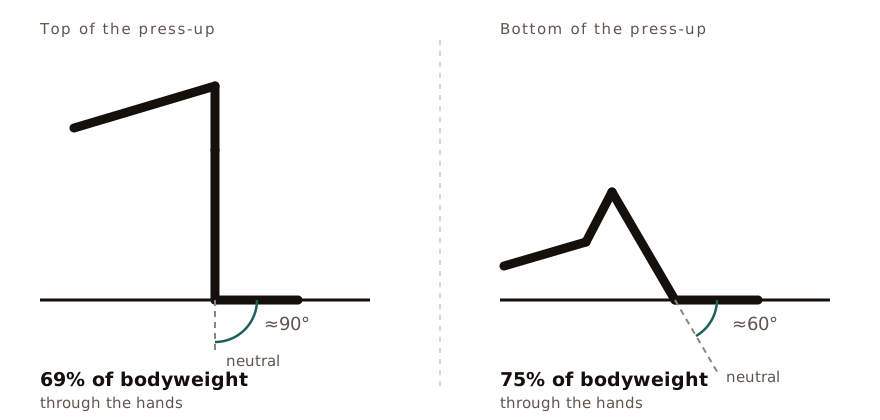
If your wrists ache when you do press-ups, there is a mechanical explanation that fits the position: at the top of the movement the wrist is bent back to close to a right angle, and at the bottom it is carrying about three-quarters of your bodyweight. You can change the grip, change the angle, or change how much weight is on your hands — and any of the three changes what the joint is being asked to do. None of them requires buying anything.
What is actually happening at the wrist
Put your palms flat on the floor, straighten your arms and bring your shoulders over your hands, and the wrist is bent back to close to a right angle. A vertical forearm and a flat palm leave it nowhere else to go. When twelve healthy people pushed a flat palm against a scale with a straight elbow — about 22lb of push — their wrists sat at 78 degrees of extension, give or take five. That was the end of the range, not a comfortable spot in it. And a study that put motion sensors on people through a battery of everyday tasks found the whole lot could be done inside 60 degrees. The straight-arm top of a press-up asks for more than either — which is also why holding a plank bothers wrists that are fine walking around.
The load runs the other way. In a standard press-up on the toes the hands carry about 69% of bodyweight at the top and about 75% at the bottom, where the wrist is actually bent back rather less. For a man of 200lb that is about 140lb at the top and about 150lb at the bottom, split across two joints that spent the rest of the week holding a phone. So one end of the rep is the angle and the other is the weight.
Cadaver wrists loaded in a press-up position tell you where the pressure goes. Compared with the same wrist loaded in a neutral, knuckles-down position, the extended position moved the point where pressure concentrates towards the back of the joint — an average of 5.7mm on the thumb side and 2.9mm on the little-finger side — and the peak pressure on the thumb side went up. Those are single-figure millimetres, which does not sound like much until you remember what is sitting on top of them. That is a statement about cadaver wrists in a loading frame, not about where yours hurts.
That is a mechanical explanation, not a diagnosis. It explains why the ache shows up in that position and eases in others, which is the pattern most men describe. It does not tell you what is going on in your particular wrist, and I am not in a position to.
Why it turns up now and not thirty years ago
Two ordinary things. The first is that you probably have not asked your wrists to do this in years, and tissue that has not been loaded in a particular way for a long time protests the first few times it is. The second is that you are likely heavier than you were at twenty-five, and every extra pound goes through the same two joints.
Both of those are ordinary physiology and arithmetic. That they are the reason your wrists ache now is my read rather than a finding, and I would rather say so than dress it up. The useful part is what follows from it: if the problem is load and angle, then load and angle are the things to change.
The three things that change it
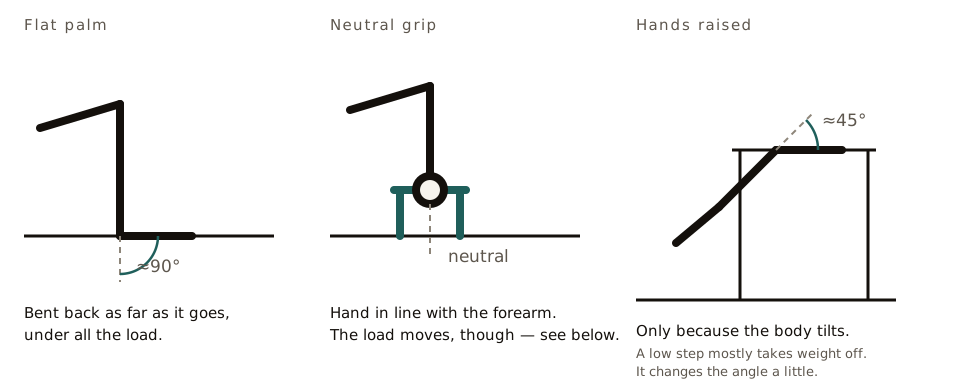
Change the grip. Get the wrist out of that bent-back position altogether. Press-up bars, hex dumbbells on the floor, or the handles of anything solid let you hold a neutral grip — the wrist stays more or less straight, the way it is when you shake hands. This is the change that goes straight at what the mechanics point to: it takes the extension out. A pair of bars costs less than a takeaway.
With one thing nobody selling them mentions, and I would rather you heard it here. The same researchers who measured the wrist went back and measured the elbow and the shoulder in the two positions. The load does not disappear when you straighten the wrist — it moves. On a neutral wrist the shoulder takes more and the elbow takes less; on a flat palm it is the other way round. If your shoulders are the part of you that complains, press-up bars are not automatically your answer, and that is worth knowing before you buy any.
Change the angle. Put your hands on something higher than the floor: the second step of the stairs, a kitchen worktop, the back of a sturdy sofa. Raising the hands does two jobs. It takes measured weight off them: in a force-plate comparison of six press-up variations, the two that produced the lowest ground reaction force were the hands-elevated version and the knees-down version. Putting your feet up on a box, which people do without thinking of it as harder, produced the highest. It can also un-bend the wrist — but only if you go high enough, and this is the part I had wrong until it was checked. Height on its own does not straighten the wrist. What straightens it is your body tilting: with your arms straight and your palms flat, the angle the wrist has to find is a right angle minus however far your body has tipped from horizontal — as long as your hands are on something level. A wall is the exception that shows why: the wall tips with you, so your palm still meets it square and you are back at ninety degrees, however high your hands are. So height buys you the angle in proportion to the tilt, not in proportion to the height. The second stair is a small tilt — call it fifteen degrees, and about fifteen degrees off the wrist — so its real job is taking weight off your hands. A worktop tips you far enough to do both properly. That is geometry, not a measurement — as far as I can find nobody has taken a protractor to it — but it follows from the position. Worktop press-ups are not a lesser exercise. They are the same exercise at a lower measured load.
Change the load. Fewer reps, more sets, and stop before the wrists start complaining rather than after. Coming down onto the knees does the same thing. There is no prize for doing them the hard way while something hurts.
One thing I would not lead with: making fists and going up on your knuckles. It does get the wrist straight, and some men are perfectly happy that way, but it asks a good deal of wrist stability and it is unforgiving on a hard floor. It is an option, not the first one. Worth knowing that the cadaver work behind all this used the knuckle position as its neutral comparison — a press-up bar puts the wrist in roughly the same part of its range, with a handle to hold instead of a floor to hit.
Do you need to buy anything
No. Stairs and a worktop are free and they solve the same problem. If you do want to spend something, a pair of press-up bars is the cheap, boring answer that does the one job that matters here — a neutral wrist — and they go in a drawer.
The larger plastic boards with the coloured slots are a different proposition, and I am working through one properly before I say anything about it. What I will say now is about the slots and only the slots: they move your hands around the floor, they do not lift them off it, so they are not what changes the angle at your wrist. Whether any particular board ships with neutral-grip handles is a question about that board, and I will answer it when I have the spec in writing.
When it is not the angle
Position explains a lot of aching wrists in press-ups. It does not explain all of them, and an article cannot tell you which yours is. Go and get it looked at properly if any of this fits: pins and needles, numbness or a hand that goes to sleep; a grip that has got weaker, or dropping things; a wrist that locks, catches or gives way; visible swelling, or swelling with heat, redness or a temperature; a visible change in the shape of the wrist; pain that wakes you at night; a wrist that hurt after a fall or a specific incident; symptoms in both wrists or both hands at once; or an ache that is still there after a couple of weeks of not doing the thing that causes it.
That list is not me diagnosing anything. It is the short list of things that deserve a professional look rather than an article, and a GP or a physiotherapist will get further with it in ten minutes than I can here.
How I checked this
The mechanics in this piece were reviewed by Kin on 31 August 2026, against the primary records rather than summaries of them. Nothing here about the body was written before that review, and where Kin's ruling and a seller's claim disagree, Kin wins.
- Established evidence In 28 strength-trained men holding the position on a force platform, the hands took 69% of bodyweight at the top of a standard press-up and 75% at the bottom (Suprak, Dawes and Stephenson, Journal of Strength and Conditioning Research, 2011;25(2):497–503 — PubMed 20179649). A separate force-plate study of six variations found that press-ups with the hands elevated and press-ups from the knees produced a lower ground reaction force than all other variations tested; feet-elevated produced the highest (Ebben and colleagues, same journal, 2011;25(10):2891–2894 — PubMed 21873902).
- Established evidence Twelve healthy wrists scanned under load, pushing a flat palm against a scale with a straight elbow: the wrist sat at 78 degrees of extension, give or take five, at the end of its range. The same scans found that under load the bones of the middle row stop keeping up with the hand, so more of the movement happens deeper in the wrist (Rainbow, Kamal, Leventhal, Akelman, Moore, Wolfe and Crisco, Journal of Hand Surgery, 2013;38(2):278–288 — PubMed 23266007).
- Early research Eight fresh cadaver wrists were loaded in two press-up positions: neutral, knuckles down, and extended, palm down. In the extended position, peak pressure in the radioscaphoid fossa — the thumb side of the joint — was significantly higher, and the centre of pressure moved towards the back of the joint by an average of 5.7mm there and 2.9mm on the little-finger side. That is a mechanism measured on cadaver tissue, not an outcome measured in men doing press-ups, and it is cited here as the former. Daly, Werner, Cavallaro, Tucci and Harley, Journal of Hand Surgery (American volume), 2018;43(4):339–345 — PubMed 29157783.
- Established evidence Fourteen volunteers on two force plates with motion capture: in a hyperextended wrist the forces travelled further towards the back of the joint, over a wider area, than in a neutral one. The authors support performing press-ups on a wrist held in neutral. Neither this study nor the cadaver work measured pain (Polovinets, Wolf and Wollstein, Journal of Hand Therapy, 2018;31(3):322–330 — PubMed 28684196).
- Established evidence Motion sensors on the wrists of volunteers through a battery of everyday tasks: the whole battery was achievable within 60 degrees of extension (Ryu, Cooney, Askew, An and Chao, Journal of Hand Surgery, 1991;16(3):409–419 — PubMed 1861019).
- Guy's opinion That this is why your wrists ache now. That tissue protests an unaccustomed load, and that extra bodyweight goes through the same two joints, are ordinary physiology and arithmetic — the guess is applying them to you.
- Early research Fourteen healthy male volunteers from the same laboratory, on the same two press-up styles, measured at the elbow and shoulder: the shoulder is loaded more when the press-up is done on a neutral wrist, the elbow less, and the forces through the two joints run close to inverse between the two styles. Published June 2026 (Polovinets, Wolf, Friedlander and Wollstein, Handchirurgie Mikrochirurgie Plastische Chirurgie, 2026;58(3):243–251 — PubMed 42269686). No injuries were measured in either study.
- What people report Across roughly 430 comments under press-up equipment reviews, the benefit owners describe most often is not the one the marketing sells: it is having their hands in the same place every repetition.
What I don't know: whether any of these three changes fixes your wrist. I have not found a trial that follows men with wrist pain through a change of grip in press-ups and reports what happened. There are trials of other things for wrist pain. Not that one, so I am not going to tell you there is one. What I can tell you is which position puts the joint under least load, and that is a different, smaller claim.