Getting back into it
A vest on the walk is extra mass, not a bone protocol
Extra load can make the walk you already do a bit harder. The papers that moved hip bone used jumping classes in postmenopausal women, not a neighbourhood stroll. Cranky knees are the other half of that sentence.
If the walk already hurts, adding mass is not a workout. Start at the last section.
The fight
One story: strap on a vest, walk the dog, save your hips. The other story: extra mass on a walk you already do makes the walk cost more oxygen and puts more compression through the knee, and the bone papers people quote are not that walk. Both things can be true at once. The mistake is selling the second as the first.
I am not in a position to diagnose your knees or your bone density. I can tell you what the opened trials measured, who sat in them, and what they refused to show. Sex and age mismatch is the story here, not a footnote. There is no opened RCT of vest-walking for BMD, knee osteoarthritis, or “useful conditioning” in men 45–65.
What the famous bone papers actually did
The paper that gets recycled as “weighted vest prevents hip bone loss” is Snow, Shaw, Winters and Witzke, 2000. Eighteen postmenopausal women. Baseline age 64.1 ± 1.6 years; 69.9 ± 1.6 at post-test. They had already finished a 9-month trial and volunteered. Nine continued weighted-vest plus jumping exercise 3 days a week, 32 weeks a year, for 5 years. Nine original controls stayed active — 5.7 ± 1.7 hours a week of weight-bearing — but did not do vest or jumping. Groups were not re-randomised; women self-selected. Vest weight across years averaged about 11.3 lb (yearly means: 14, 13, 15, 7, 7 lb). Jumps per session averaged 51.7 ± 7.5. Compliance 83.6 ± 2.4%. Exercisers: femoral neck +1.54% ± 2.37%, trochanter −0.24% ± 1.02%, total hip −0.82% ± 1.04%. Controls: −4.43% ± 0.93%, −3.43% ± 1.09%, −3.80% ± 1.03%. Change differed between groups at all three hip sites. Authors: “a 5-year program of weighted vest plus jumping exercise maintains hip BMD by preventing significant bone loss in older postmenopausal women.” Two exercisers and three controls were on estrogen more than 6 years. No new injuries from jumping. The authors themselves note they did not see a hip BMD increase after the original 9 months. n=9 versus 9. Not an RCT. Not walking. Not men.
The 9-month parent trial is Shaw and Snow 1998, the protocol Snow 2000 followed. Forty-four community-dwelling Caucasian women aged 50–75, at least 5 years past menopause (36 estrogen-deplete). Half did 9 months, 3 times a week, 60-minute classes: warm-up walking, 35 minutes of lower-body resistance with a vest — squats, lunges, stepping, toe raises, then jumps — cool-down. Vests unused the first 2 weeks. Initial vest resistance 5% of body weight, plus about 1–2% every 2 weeks to 10%; beyond 10%, plus 0.5–1% every 2 weeks, periodised with about 4% “valleys.” Highest end-program resistance 16–20% of body weight, individualised. Jumping progressed on a pad, then from a 4-inch height. Lateral stability improved; lower-body strength +16–33%; muscular power +13%; leg lean mass +3.5% versus controls. No significant change in femoral-neck bone mass in exercisers or controls. No injuries directly from training. The authors’ conclusion is about fall-risk indices, not BMD. The vest was the barbell substitute for lower-body drills, not extra mass for an otherwise unchanged stroll. BMD was a null at 9 months even with jumps.
INVEST 2025 is the largest modern vest RCT, and it asked a different question. Beavers and colleagues, Wake Forest, single-blind 12-month trial, 150 randomised (50 per arm), 133 (88.7%) completed. Mean age 66.4 ± 4.6 years; 112 women (74.7%), 38 men (25.3%); BMI 33.6 ± 3.3. Arms: caloric restriction targeting 10% weight loss; weight loss plus vest; weight loss plus supervised progressive resistance training 3 times a week (3 sets of 10–12 at 70–75% 1RM, 8 exercises). Vest goal: 8 hours a day of most-active-day wear; started as a 1-lb unloaded vest, then weekly 1/8-lb blocks titrated toward replacing lost weight, cap 10% of baseline weight. Weight loss similar across arms, 9.0–11.2%. Vest wear 7.1 ± 1.5 hours a day; 78.0 ± 29.9% of lost weight replaced in the vest. RT attendance 71.4 ± 19.1% of sessions. Total-hip trabecular vBMD fell in all groups at 12 months (−1.2% to −1.9%). Weight-loss plus vest versus weight loss: +0.91 mg/cm³ (97.5% CI −0.27 to 2.09; p=.13). Vest was non-inferior to RT. Same pattern for total-hip aBMD. P1NP (formation) rose in vest and RT versus diet alone (p=.02); CTX (resorption) did not differ. Knee-extensor strength rose only in RT. Musculoskeletal adverse events: diet 6, vest 17, RT 19. Six serious adverse events, none related. Exclusions included osteoporosis, and severe arthritis or back pain that precluded vest use or exercise. Authors: neither vest nor RT mitigated weight-loss-associated hip bone loss; “exercise may be insufficient on its own.” Do not spin P1NP into “therefore bone is saved.” This is wear-during-the-day while dieting, not vest-walking as the workout, and three-quarters of the sample were women in their mid-60s. Kelleher 2017, INVEST’s own 6-month pilot described in the opened paper, was n=37, hip aBMD −0.6% versus −2.0% (p=.08) — a signal, not a win. The powered follow-up did not confirm hip BMD protection.
Greendale 2000 is the clean test of “just wear a light vest around the house.” Twenty-seven-week unmasked RCT. 62 women and men, mean age 74. Arms: no vest (n=21), 3% body-weight vest (n=19), 5% (n=22). Nylon pocketed vest, 2 hours daily, 4 days a week. No specific physical activities mandated. Primary outcome: peak isokinetic knee-extensor strength. Also endurance, timed performance, serum osteocalcin, urinary N-telopeptides, quality of life. No between-group differences at 27 weeks on any of those. Authors: “the training stimulus afforded by the vest (at the dosage tested) was below the required amount to produce strength gains or bone stimulation.” It does include men. They are about 74, not 45–65, and the result is a null.
BEST — Bone Estrogen Strength Training, Going and colleagues — is the other name that gets dragged toward vest walking. Sedentary postmenopausal women, HRT or no HRT, randomised to exercise versus no exercise; all took 800 mg/day calcium citrate. 266 women, aged 45–65, completed year 1. Sessions 60–75 minutes, 3 nonconsecutive days a week: warm-up, 8 resistance exercises at 70–80% 1RM (2 sets of 6–8), moderate-impact cardio, stair climbing on step boxes while wearing weighted vests, stretching and balance. Year-1, as reported in the opened ACSM Health & Fitness Journal piece: HRT plus exercise plus calcium about +1–2% femoral neck and trochanter BMD; no-HRT plus exercise plus calcium about +1% trochanter; no-HRT / no-exercise lost BMD. Authors: resistance exercise is the most important component and appears dose-responsive. 167 women completed 4 years; highest tertile of attendance (70.3 ± 12.6%) had greater BMD benefit at all sites. A search for a Going RCT of vest-walking-only BMD did not surface a paper to open. Vest appears as loaded stairs inside a lifting program. Population is postmenopausal women.
Two smaller women’s trials sit in the same pile. Jessup 2003: 18 women, age 69.2 ± 3.5 years, RCT, 32 weeks, 3 one-hour sessions a week of supervised strength plus walking plus stair climbing plus balance while wearing weighted vests, versus sedentary controls; all took calcium plus vitamin D. Exercisers: significant femoral-neck BMD improvement, better balance, significant weight loss. n=9 versus 9. Klentrou 2007: 16 postmenopausal women (9 exercise / 7 control), 12 weeks, 3 multimodal sessions a week, vest progressed weekly to a maximum 15% of body weight. NTx −14.5% in exercisers; osteocalcin unchanged; no DXA BMD. Ankle plantar-flexion +40%; 80% compliance. Neither is men 45–65.
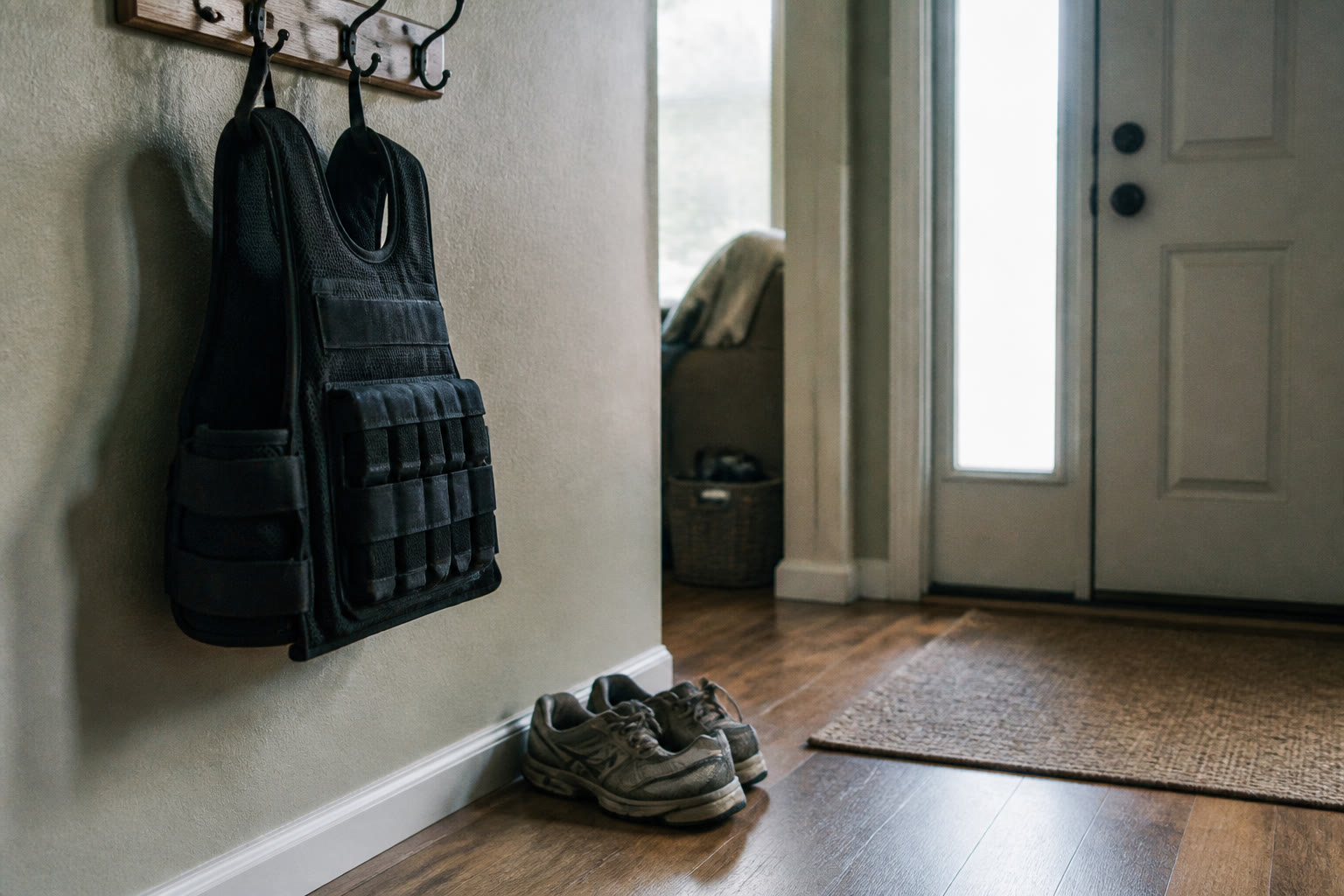
What a vest on a walk actually changes
Acute treadmill studies show vest walking costs more oxygen and raises ground-reaction force. Those data are young samples. They support “the walk gets harder.” They do not show bone gain in midlife men.
Puthoff 2006: n=10, age 23.4 ± 1.7 years. Treadmill 4-minute stages at 0.89, 1.12, 1.34, 1.56, 1.79 m·s⁻¹ under vest loads 0, 10, 15 and 20% of body mass. VO2: significant vest × speed interaction; 0% differed from all loaded conditions, and 10% versus 20% at all speeds. Relative intensity: no vest effect at slower speeds; significant at higher speeds. Vertical GRF peaks F1 and F2: 0% less than 10, 15, 20% body mass; 10% differed from 20%. Loading rate: 0% differed from 15% and 20%. Conclusion: a vest “can increase the metabolic costs, relative exercise intensity, and loading of the skeletal system during walking.” Age 23. Not OA knees.
Looney 2024, USARIEM, ACSM journal: n=20 military-age adults (16 men, 4 women; 26 ± 8 years; 81 ± 16 kg) walked 6–21 minutes with vest loads 0–66% body mass at 0.45–1.97 m·s⁻¹. New LCDA vest term: metabolic rate multiplier includes 1.38 × LVs^1.21 (LVs = vest mass / body mass). Backpack term is steeper: 1.96 × LBp^1.36. Vest estimates statistically equivalent to measured metabolic rate (bias −0.01 ± 0.54 W·kg⁻¹). Vest loads sit closer to the centre of mass and can be split front and back, so they cost less energy than the same mass in a rucksack. Datta and Ramanathan 1971 is cited as front-and-back torso carriage cutting metabolic demand about 9% versus backpack. External validation: 264 people, 55 women, 18–43 years. Authors explicitly say the calculator is for tactical and recreational vest users for work/rest and periodisation — not a bone trial. The 22/44/66% body-mass loads are military approach-march echelons, not a 10-lb fitness vest. I am not going to invent a calorie-burn percentage for a 55-year-old from Looney’s watts.
ACSM’s 2020 consumer page (DeSimone) says the useful, modest thing: a vest immediately increases body weight, so more resistance on squats and push-ups, higher oxygen consumption for walking and hiking, more power on jumps and sprints. “Because of the added stress on the joints,” vests are often discussed for osteopenia and osteoporosis — “varies by individual, so seek medical counsel first.” Master form before adding load. “Not advised for long-distance running or long-duration high-impact.” Start 10 to 15 minutes, then increase time. ACSM does not publish a percent-body-weight walking prescription on that opened page.
No opened paper states a universal percent-body-weight prescription for walking. Shaw started 5% on class exercises, not walking, and peaked 16–20%. Klentrou peaked 15% on multimodal sessions. Greendale found 3% and 5% wear-only insufficient. INVEST titrated toward replacing lost weight. Puthoff tested 10/15/20% in 23-year-olds. Manufacturer “5–10% for walking” talk is spec-page marketing. I am not going to print “use 10% body weight” as if it were a dose.
The load goes through the knee
Lenton 2018 modelled tibiofemoral contact force in 21 male Australian Army Reserve soldiers, age 29.5 ± 7.1 years, 82.8 ± 12.1 kg. Unloaded versus four armour types at 15 kg and 30 kg. Treadmill 10 minutes at 1.53 and 1.81 m·s⁻¹. Armour type: no effect, small effect sizes, even at fast walk plus 30 kg. First-peak medial contact about 4 × body weight regardless of armour. Load magnitude: 15 kg and 30 kg → +10.1% and +19.9% peak medial knee joint contact force versus unloaded. 30 kg also raised second-peak total contact force +28.3% versus unloaded and +12.9% versus 15 kg. Faster walking raised first-peak medial (3.61 ± 0.78 versus 3.15 ± 0.78 body weight) and total contact force. Fast walk plus 30 kg: peak total tibiofemoral contact about 5 × body weight, approaching running magnitudes of about 6 ×. Muscles contributed more than 70% of medial and more than 65% of lateral contact. Authors: soldiers carrying more than 15 kg for prolonged periods could be at greater knee musculoskeletal-injury risk. They cite Bennell 2011 that higher dynamic medial knee load predicts faster cartilage loss in people who already have medial OA. They do not have radiographs of disease onset from this protocol. 15 kg is about 33 lb — heavier than typical walking-vest marketing. This is not an OA trial in 45–65-year- old civilians. It does show: extra torso mass → extra modelled knee compression, and vest-versus-ruck distribution is not a knee-unloading trick.
So “vest is easier on the back than a ruck” can be true for energy cost (Looney) without being easier on the knee (Lenton). ACSM’s 2025 osteoarthritis hot topic wants aerobic plus flexibility plus strength for OA, at least 2 strength sessions a week. “Joint impact associated with some power activities may temporarily aggravate OA joint pain”; the fix is reduce impact or load, swap the irritating drill, or go to the pool. Mentions power programs “with weights, a weighted vest or in a pool” as OA training tools — not as all-day walking load. INVEST excluded severe arthritis. No opened vest RCT in an untreated OA flare or acute knee injury.
Do you need to buy anything
Not for bone, if what you were promised is Snow 2000 on a walk. The papers that moved hip BMD in older adults used the vest as resistance for squats, lunges, steps and jumps, 3 days a week, for months to years — still in women, still not a guarantee in a 55-year-old man. Progressive lifting remains the dose-responsive piece in BEST. Wear- only at 3–5% body weight did nothing in Greendale. Daily vest during ~10% weight loss did not save hip bone in INVEST.
If your knees and spine are quiet, a snug, even front-and-back vest can make the walk you already do a bit harder. Treat it as graded extra mass, not a new sport. Start as ACSM says: 10 to 15 minutes, then time before load. Buy for adjustable, even load and a real size chart. Hyperwear PRO max capacity by size: SM 20 / MD 25 / LG 30 / XL 40 lb. FAQ: FIT women-specific vest up to 10 lb; TAC plate vest up to 40 lb. The same pages market “5–10% of body weight” for walking and osteoporosis — that is brand copy, not a trial result. Rogue Plate Carrier: max plate capacity 40 lb (20 front / 20 back); plates sold 5 / 7.5 / 10 / 20 lb pairs; “fitness accessory,” not armour. That is hardware. It is not a prescription.
When this is not the article
INVEST excluded osteoporosis and severe arthritis or back pain that precluded vest use or exercise. ACSM 2020: physician first; added stress on the joints; skip long-distance running and long-duration high-impact in a vest. ACSM OA 2025: if extra load aggravates joint pain, reduce it. No opened paper used the exact phrase “acute knee injury” or “untreated OA flare” as a vest contraindication — those are clinical common sense adjacent to the exclusions above, not trial endpoints. If the walk already hurts, adding mass is a compressive experiment, not extra cardio.
I am not in a position to read your DEXA or your knee. A GP or a physiotherapist will get further with a flared joint in ten minutes than a vest will.
How I checked this
Kin reviewed 2 September 2026, against the primary records rather than summaries of them. Nothing here about the body was written before that review, and where Kin's ruling and a seller's claim disagree, Kin wins.
- Early research Snow CM, Shaw JM, Winters KM, Witzke KA. J Gerontol A Biol Sci Med Sci. 2000;55(9):M489–M491. PMID 10995045 — doi:10.1093/gerona/55.9.m489, opened PDF. 5-year vest plus jumping in older postmenopausal women, n=9 vs 9, self-selected, not an RCT. Hip BMD maintained vs controls who lost ~3–4%. Not a walking trial. Not men.
- Early research Shaw JM, Snow CM. J Gerontol A Biol Sci Med Sci. 1998;53(1):M53–M58. PMID 9467434 — doi:10.1093/gerona/53a.1.m53. 9-month vest as resistance for squats/lunges/jumps in women 50–75. Strength and balance up; femoral-neck bone mass did not move. Started 5% body weight after 2 weeks unloaded; peaked 16–20%.
- Established evidence Beavers KM et al. INVEST. JAMA Netw Open. 2025;8(6):e2516772 — doi:10.1001/jamanetworkopen.2025.16772, PMC12181796. n=150, mean age 66.4, 74.7% women. Daily vest during ~10% weight loss did not prevent hip bone loss vs diet alone (p=.13). RT also failed. Wear 7.1 ± 1.5 h/d. Kelleher 2016/17 pilot in the same paper: n=37, p=.08 — not confirmed.
- Early research Greendale GA et al. J Am Geriatr Soc. 2000;48(3):305–311. PMID 10733058 — doi:10.1111/j.1532-5415.2000.tb02651.x. Mixed-sex, mean age 74, 3% or 5% body weight, 2 h/d, 4 d/week, no exercise prescription: no strength, function, or bone-marker change.
- Early research Puthoff ML et al. Med Sci Sports Exerc. 2006;38(4):746–752. PMID 16679992 — doi:10.1249/01.mss.0000210198.79705.19. n=10, age 23.4. Vest walking raises VO2, intensity and GRF. Looney DP et al. Med Sci Sports Exerc. 2024;56(6):1177–1185. PMID 38291646 — doi:10.1249/MSS.0000000000003400, OSTI PDF. n=20, age 26 ± 8. Vest metabolic multiplier 1.38 × LVs^1.21; backpack 1.96 × LBp^1.36. Not a bone trial.
- Early research Lenton GK et al. PLoS One. 2018;13(11):e0206859 — doi:10.1371/journal.pone.0206859, full text. 21 male soldiers, age 29.5. 15 kg and 30 kg torso load → +10.1% and +19.9% peak medial knee contact force. Armour type did not change it. Not an OA clinic sample.
- Early research BEST / Going, as described in Houtkooper et al. ACSM’s Health & Fitness Journal 2007;11(1) — opened PDF citing Going 2003 (Osteoporos Int. 14:637–643) and Cussler 2005 (16:2129–2141). Vest on step boxes inside lifting plus impact, postmenopausal women 45–65. Resistance exercise the dose-responsive piece. Not vest-walking-only.
- Early research Jessup JV et al. Biol Res Nurs. 2003;4(3):171–180 — doi:10.1177/1099800402239628 (18 women, 69.2 y, vest plus walking/stairs/strength). Klentrou P et al. J Aging Phys Act. 2007;15(3):287–299 — doi:10.1123/japa.15.3.287 (16 postmenopausal women, vest to 15% BW, NTx −14.5%, no DXA).
- Established evidence DeSimone GT. ACSM shareable, ACSM’s Health & Fitness Journal 2020;24(2):4 — doi:10.1249/FIT.0000000000000546, full text. Physician first; start 10–15 minutes; not for long-distance running or long high-impact. ACSM OA hot topic, Vincent & Vincent, 20 May 2025 — ACSM: if extra load aggravates OA pain, cut it.
- Seller's claim Hyper Vest PRO capacity SM 20 / MD 25 / LG 30 / XL 40 lb — product page; FAQ FIT up to 10 lb, TAC up to 40 lb — FAQ. “5–10% of body weight” for walking is brand copy. Rogue Plate Carrier max 40 lb — Rogue. Hardware ceilings, not a medical dose.
What I don't know: whether vest walking builds or preserves hip bone in men 45–65. That trial was not in the opened set. I do not have a universal walking % body-weight dose, and I will not invent one. Lenton is modelled contact force in healthy young soldiers at 15–30 kg, not an OA outcome trial. Going has no opened vest-walking-only BMD RCT. Kelleher 2017 full PDF was blocked; numbers above are as INVEST described them.