Getting back into it
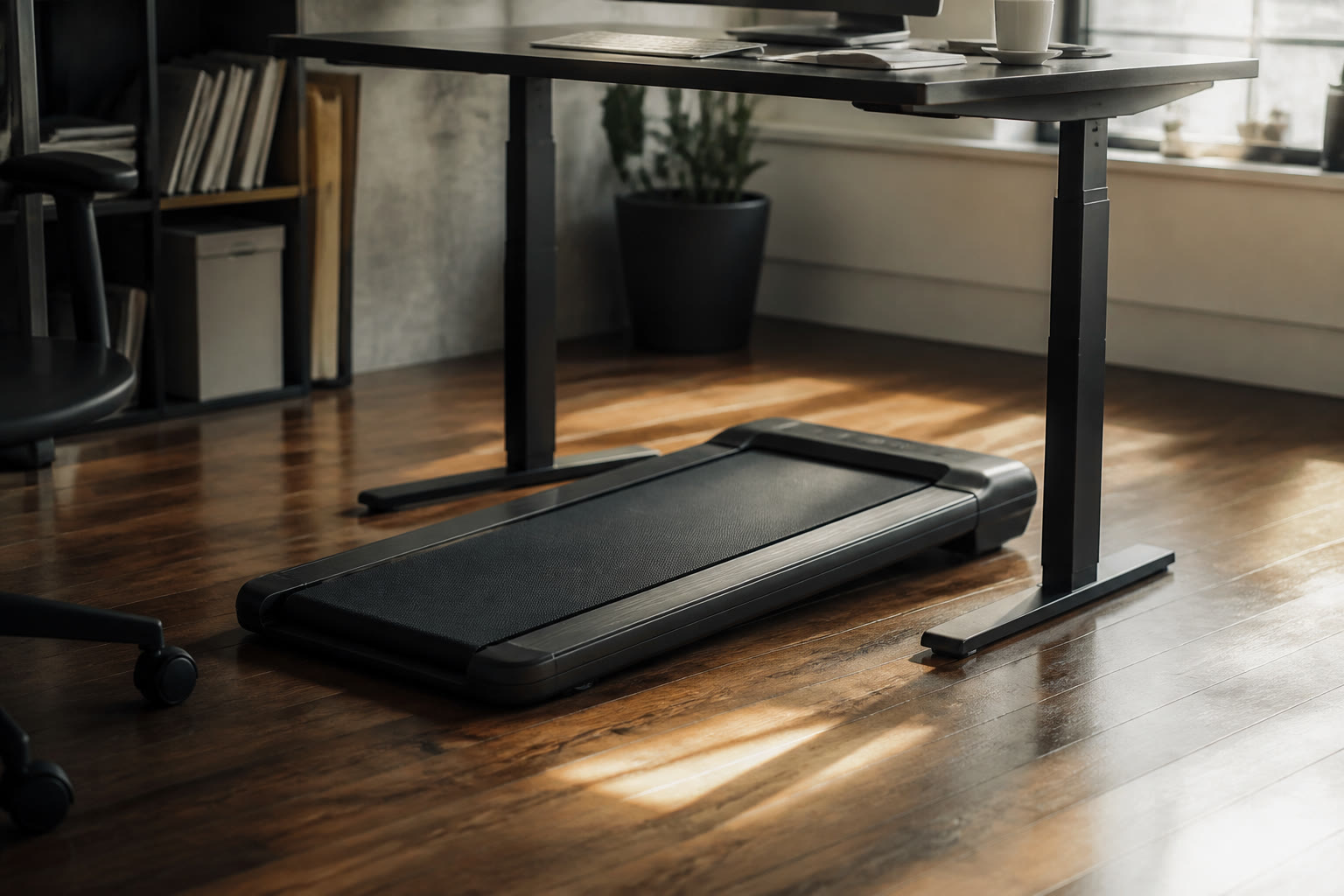
A walking pad is not a walk: desk-speed NEAT vs the 150-minute week
Slow treadmill walking at a desk does raise energy expenditure against a chair. It is light intensity, not ACSM or CDC “brisk walking,” and it is not a substitute for a real walk or for training.
If your balance is already a problem, or you have neuropathy, or there are pets and kids in the same room as a belt with no rails, start at the last section. A gadget is not a diagnosis, and I am not in a position to give you one.
The fight is simple. Slow walking at a desk can raise energy expenditure and chip sitting time. A $200–400 fold-flat pad — or a four-figure workstation — is still light-intensity movement. It is not ACSM or CDC brisk walking. It is not a substitute for a real walk, and it is not training. Almost every paper I opened is about treadmill desks, not the TikTok SKU. I am not going to launder one as the other.
What a desk treadmill actually measures
Levine’s NEAT work is real, and it is not a consumer walking pad. Sixteen nonobese volunteers overfed 1,000 kcal/day above weight-maintenance for eight weeks. Two-thirds of the rise in total daily energy expenditure was nonexercise activity thermogenesis — fidgeting, posture, ambulation, the ordinary fidget of a day. Changes in NEAT accounted for the ten-fold differences in fat storage and predicted resistance to fat gain (r = 0.77, p < 0.001). The Endotext chapter that sits on that paper: mean TEE rise about 554 kcal/day; about 336 kcal/day attributed to activity thermogenesis with exercise held constant; individual NEAT change from −98 to +692 kcal/day. NEAT can vary by as much as about 2,000 kcal/day between two similar-sized adults, driven largely by occupation. That study does not test under-desk walking pads. It does not show that buying a pad will produce a 336 kcal/day NEAT increase. It is overfeeding physiology in 16 young nonobese adults, not a 45–65 male training trial.
What a treadmill desk does, in a lab, for one hour, in people with obesity, is raise energy expenditure against sitting. Levine and Miller, 2007: 15 sedentary adults with obesity, 14 women and 1 man, mean age 43, BMI 32. Indirect calorimetry. Sitting at a computer: 72 (SD 10) kcal/h. Walk-and-work at a self-selected 1.1 (0.4) mph: 191 (29) kcal/h. Mean increase versus sitting: 119 (25) kcal/h. Their table also reports walking 1 mph 198 kcal/h, 2 mph 254, 3 mph 307. All 15 tolerated one hour; no injuries, falls or unsteadiness. The device was a custom vertical workstation over a treadmill, about £1,000 / $1,600, not a fold-flat pad. Then the sentence the affiliate internet never lets go of: if sitting computer-time were replaced by walking-and-working 2–3 hours a day “and if other components of energy balance were constant, a weight loss of 20–30 kg/year could occur.” That is a ceteris-paribus thought experiment. It is not a 12-month weight change. It does not test typing, cognition, or all-day use. Self-selected speed was about 1.1 mph — light intensity, not a training walk. If I write “walk off 20 kg at your desk,” that is a lie.
The best long-term RCT of treadmill workstations missed its primary endpoint. Bergman and colleagues, Lancet Public Health 2018: 80 office workers in Umeå, aged 40–67, BMI 25–40, sedentary jobs. Treadmill workstation for optional use — instructed at least an hour a day, self-chosen speed — at an existing sit-stand desk, versus sit-stand as usual. Primary: activPAL walking time on weekdays and weekends, to 13 months. Weekday walking +18 minutes (95% CI 9 to 26) in the intervention against +1 minute (−7 to 9) in control; difference 22 minutes (7 to 37). Weekend: no between-group gain. The predetermined primary of a 30-minute difference was not met. I opened the abstract and a companion commentary, not the full PDF — Cloudflare blocked it. Commentary: no effect on daily sitting time (p = 0.44); no significant effects on anthropometrics, body composition, or other health-related outcomes; walking effects largest early, then attenuated. One adverse event: a participant “accidently stepped on their Achilles tendon.” Control already had sit-stand desks, so this is treadmill-desk versus sit-stand, not versus a fully seated office. It does not test a $200–400 walking pad without a height-adjustable desk, rails, or an occupational install. Conference-level reports of MVPA compensation were not verified in the full paper. I am flagging that as unverified.
Koepp’s one-year Mayo treadmill-desk trial is prospective and uncontrolled. Thirty-six employees, 25 women and 11 men, BMI 29 ± 7. Traditional desk replaced with a treadmill desk for a year. No randomised control group. Daily accelerometer activity: 3,353 ± 1,802 AU/day at baseline, 4,460 ± 2,376 at six months, 4,205 ± 2,238 at twelve (both p < 0.001 versus baseline). Sedentary time, zero activity: 1,020 ± 75 min/day to 929 ± 84 at six months to 978 ± 95 at twelve. Whole-group weight −1.4 ± 3.3 kg (p < 0.05); obese subgroup −2.3 ± 3.5 kg (p < 0.03). Whole-group fat mass did not change significantly. Among those who lost weight (n = 22), fat mass −3.4 ± 5.4 kg. Authors: deployment “was not associated with altered performance.” Intro: office tasks while walking at about 1 mph, energy expenditure up about 100–150 kcal/h. Their table: 1 mph about 176 kcal/h, 2 mph 241, 3 mph 313 at baseline. Not an RCT. Not a walking-pad study. Does not prove a consumer pad produces 1.4 kg of loss. The sedentary-time win shrank from six to twelve months. The fat-mass null for the full sample is easy to bury in affiliate copy.
Light is not the 150-minute week
Sitting time is associated with higher mortality. Wiping that association out in Ekelund’s 2016 analysis took about 60–75 minutes a day of moderate activity — far above desk-pace walking and far above the CDC 150 minutes/week floor. Thirteen studies, 1,005,791 people, 84,609 deaths. Versus the referent of under 4 hours sitting a day plus the most-active quartile (>35.5 MET-h/week): sitting more than 8 hours a day in the lowest activity quartile, HR 1.59 (1.52–1.66). Sitting more than 8 hours a day in the most active quartile, HR 1.04 (0.99–1.10) — not increased. Least sitting (under 4 hours) plus lowest activity still HR 1.27 (1.22–1.31). Interpretation, in their words: “High levels of moderate intensity physical activity (ie, about 60–75 min per day) seem to eliminate the increased risk of death associated with high sitting time.” That high activity “attenuates, but does not eliminate” high TV-viewing risk. Self-reported sitting and activity. Observational, not a treadmill-desk trial. 60–75 minutes a day of moderate is about 420–525 minutes a week — three times the CDC aerobic floor. It does not say a walking pad, standing, or light 1–2 mph desk walking eliminates sitting harm.
Device-measured data still show more sedentary time, more death. Ekelund 2019, BMJ: eight cohorts, 36,383 people, mean age 62.6, 2,149 deaths. Any intensity of activity associated with lower mortality (most-active quartile HR 0.27 versus least-active). Light-activity quartiles HR 1.00 / 0.60 / 0.44 / 0.38. Sedentary quartiles HR 1.00 / 1.28 / 1.71 / 2.63. A statistically significantly higher risk of death at sedentary times of 9.5 or more hours daily. Ten and 12 hours a day sedentary: HR 1.48 (1.22–1.79) and 2.92 (2.24–3.83). Light activity helps. That is not the same as calling 1–2 mph desk walking your aerobic minutes.
The Physical Activity Guidelines for Americans, 2nd edition, 2018: light-intensity is under 3.0 METs, “walking at a slow or leisurely pace (2 mph or less)”; moderate is 3.0 to under 6.0 METs, “walking briskly (2.5 to 4 mph).” Key adult guideline: move more and sit less; 150–300 minutes a week moderate or 75–150 vigorous, plus muscle-strengthening at least two days. CDC: 150 minutes a week moderate — example, brisk walking 30 minutes times five; talk-but-not-sing test; examples of moderate include “walking fast,” not slow strolling. ACSM’s restatement: at least 30 minutes moderate on at least five days, or at least 20 minutes vigorous on at least three, plus strength at least two days. They do not credit 1.0–1.5 mph treadmill-desk walking as moderate aerobic minutes. PAG explicitly could not set a numeric sedentary-time target. Muscle-strengthening is a separate requirement a walking pad does not meet.
Acute productivity studies at desk-walking speeds show worse typing. Larson 2015: 75 people, randomised, 1.5 mph versus sitting, college sample, about 45 minutes. Treadmill group worse total AVLT learning (52.3 versus 56.2 words, p = 0.03), worse PASAT (126.6 versus 138.5 correct, p = 0.03), slower and less accurate typing (net 41.1 versus 54.0 WPM, p = 0.001). Recall after delay not different; scores still in the average range against norms. Authors: “modest” cognitive and typing hits “may not outweigh the benefit of the physical activity gains,” but this was one naïve session, 18–35-year-old students, on a non-adjustable desk height. John 2009 I have as an abstract only, quoted inside Larson and on PubMed: seated versus walking, 6–11% worse mouse, typing and maths; attention and reading not significant. Koepp’s year-long workplace study claimed performance was not altered. Cochrane 2018 on sitting at work: sit-stand desks reduce sitting about 100 minutes per workday short-term, low-quality evidence; treadmill desks “had unclear or inconsistent effects on sitting time.” Quality “low to very low.” They do not prove long-term productivity loss, or gain, on a walking pad, and they do not measure 45–65 male knowledge-work over months.
The pad is not the Mayo desk
Opened manufacturer pages. WalkingPad C2, US site: speed 1–4 mph (the page also says a maximum of 6 km/h; FAQ: “you can’t run on it”); walking area 47.2 × 15.7 in; weight capacity 220 lb (100 kg); motor “3 HP brushless”; unit 55 lb; 1-year warranty; no side rails listed. WalkingPad C1, UK site: 0.5–3.7 mph (0.5–6 km/h); 220 lb / 100 kg; 48 lb / 22 kg unit; listed sale £309, regular £469 on that page. LifeSpan TR1200-Omni desk: $2,139; speed 0.4–4.0 mph (“Max. Speed Can Be Set to 2.0 MPH if Desired”); max user 330 lb; recommended use 6 hours daily; walking surface 20" × 48"; step-up 4.6"; 10-year frame, 2-year parts, 1-year labour. LifeSpan TR1200Pro-GlowUp under-desk base: $1,299; 0.4–4.0 mph with an optional 2.0 mph cap; 330 lb; 6 hours a day; 20" × 48" belt; Intelli-Guard “ensures the treadmill only operates when you are actively walking”; “Walking at an incline while working is not recommended by ergonomists.”
These are walking machines, not running machines. C-series WalkingPads are 220 lb, a belt about 16 inches wide, no real handrails, a 1-year warranty. LifeSpan office units are heavier-duty, wider belt, 6 hours/day rating, optional 2 mph cap for desk work, and cost four figures. Levine-style research speeds, about 1–1.5 mph, sit in the low end of all of these ranges. Pages do not publish independent kcal, VO2, or injury data. “3 HP” on a 55 lb pad is a marketing motor rating, not a lab output. No opened page claimed FDA clearance for a medical indication. Powered exercise equipment intended for medical purposes is Class I and 510(k)-exempt under 21 CFR 890.5380. Consumer walking pads marketed as wellness or fitness are generally not medical devices. I did not open a 510(k) for WalkingPad or LifeSpan as a treatment for obesity, CVD, or sitting disease. Do not write “FDA-cleared for…”
Topic copy likes $200–400. Opened LifeSpan pages are $1,299–$2,139. Opened WalkingPad C1 UK is £309 on sale. A US C2 street price as a numeral was not on the opened page — only “Save 25%.” I am not inventing one.
What I would actually do
If you sit most of the workday, replacing some sitting with slow walking is real NEAT, in the Levine sense: extra calories versus a chair, some step accumulation, a sit-break. Levine 2007: about +119 kcal/h at 1.1 mph in the lab. That is “better than nothing,” which PAG and CDC also say. Pair it with a stable standing desk, slow speed — research and LifeSpan office practice cluster at about 1–2 mph — proper footwear, and no dual-tasking that needs precision typing or numbers. Keep the real walk and the training. CDC/ACSM: 150–300 minutes a week of moderate, brisk, plus two days of muscle. Ekelund 2016: the sitting-mortality association only flattened at about 60–75 minutes a day of moderate activity in the most active quartile. A pad at 1–2 mph does not replace a brisk outdoor walk, VO2 work, or lifting.
What I will not dress up. “Walk 10,000 desk steps and your cardio is done.” “Lose 20–30 kg/year without changing diet” — Levine’s thought experiment, contradicted by Bergman and Koepp’s outcomes. “Same as a 3 mph neighbourhood walk,” or “counts as your 150 minutes,” at typical desk speeds. “FDA-cleared.” “Clinically proven fat loss.” “No productivity cost” as a blanket. Equating a 220 lb, 16-inch belt, 1-year-warranty pad with the Mayo and LifeSpan workstation literature. Injury-free claims, especially for no-rail pads, pets, kids, socks-only use, or men with neuropathy or vestibular trouble. No dedicated epidemiology of walking-pad falls was opened. Levine 2007: no falls in 15 people for one lab hour. Bergman: one Achilles event over 13 months. Absence of a large injury trial is not “proven safe.”
Thompson 2014 and Thompson 2008 exist as abstracts in this pass. I did not open the full PDFs. I am not quoting them as if I had.
Do you need to buy anything
No. A neighbourhood walk at a talk-but-not-sing pace is the aerobic minute the guidelines actually count, and it does not require a belt. Stairs, a lunch loop, a dog. If you do buy a pad, buy to spec, not vibe: weight rating versus the actual user — WalkingPad C-series 220 lb on the opened page, a hard miss for many men 45 to 65; belt width; whether the unit is rated for hours a day (LifeSpan 6 hours; walking-pad pages opened here did not state an hours/day duty cycle); rails or auto-stop if balance is an issue. I am not putting a fake affiliate URL under a 16-inch belt.
When this is not the article
Balance that is already unreliable, peripheral neuropathy, vestibular disease, a recent fall, or a house full of pets and children around a no-rail belt is not a gadget question. Chest pain on walking, unexplained breathlessness, or a clinician who has already limited your walking belongs with that clinician. I am not in a position to diagnose you. A GP or a physiotherapist will get further with a fall history in ten minutes than I can here.
How I checked this
Kin reviewed this piece on 2 September 2026, against the primary records rather than summaries of them. Nothing here about the body was written before that review, and where Kin's ruling and a seller's claim disagree, Kin wins.
- Established evidence Levine JA, Eberhardt NL, Jensen MD. Role of nonexercise activity thermogenesis in resistance to fat gain in humans. Science. 1999;283(5399):212–214. 16 nonobese volunteers overfed 1,000 kcal/day for 8 weeks. Two-thirds of the TEE rise was NEAT; NEAT changes accounted for 10-fold differences in fat storage (r = 0.77, p < 0.001). Opened as abstract — DOI 10.1126/science.283.5399.212, PubMed PMID 9880251. Endotext chapter opened in full (von Loeffelholz & Birkenfeld, updated 25 Nov 2022): mean TEE rise ~554 kcal/day; ~336 kcal/day activity thermogenesis; NEAT change −98 to +692 kcal/day; occupation can drive ~2,000 kcal/day between similar adults — NCBI Bookshelf NBK279077. Does not test walking pads.
- Early research Levine JA, Miller JM. The energy expenditure of using a “walk-and-work” desk for office workers with obesity. Br J Sports Med. 2007;41(9):558–561. n=15 (14 women, 1 man; mean age 43, BMI 32). Sitting 72 (SD 10) kcal/h; 1.1 (0.4) mph 191 (29) kcal/h; mean +119 (25) kcal/h. Table: 1 mph 198, 2 mph 254, 3 mph 307 kcal/h. 20–30 kg/year is an “if energy balance were constant” extrapolation, not an observed 12-month outcome. Custom ~£1,000 / $1,600 workstation. DOI 10.1136/bjsm.2006.032755.
- Early research Bergman F et al. Treadmill workstations in office workers who are overweight or obese: a randomised controlled trial. Lancet Public Health. 2018;3(11):e523–e535. n=80, ages 40–67. Weekday walking difference 22 min (7 to 37); predetermined 30-min primary not met. Commentary extract: no sitting-time effect (p=0.44); no body-composition effect; one Achilles event. Full Lancet PDF not opened. DOI 10.1016/S2468-2667(18)30163-4, NCT01997970. Commentary DOI 10.1016/S2468-2667(18)30198-1.
- Early research Koepp GA et al. Treadmill desks: A 1-year prospective trial. Obesity. 2013;21(4):705–711. n=36, no randomised control. Activity 3,353 ± 1,802 to 4,205 ± 2,238 AU/day at 12 months. Sedentary (zero activity) 1,020 ± 75 to 978 ± 95 min/day. Whole-group weight −1.4 ± 3.3 kg; fat mass NS for the whole group. Intro ~100–150 kcal/h at ~1 mph. DOI 10.1002/oby.20121, NCT01461382.
- Established evidence Ekelund U et al. Lancet. 2016;388(10051):1302–1310. 13 studies, 1,005,791 people, 84,609 deaths. Sitting >8 h/day + lowest activity HR 1.59 (1.52–1.66); sitting >8 h/day in most active quartile HR 1.04 (0.99–1.10). About 60–75 min/day moderate activity associated with wiping the sitting-mortality association. Observational, self-report. DOI 10.1016/S0140-6736(16)30370-1. Ekelund U et al. BMJ. 2019;366:l4570. 8 cohorts, n=36,383, mean age 62.6. Light PA quartiles HR 1.00 / 0.60 / 0.44 / 0.38; sedentary quartiles 1.00 / 1.28 / 1.71 / 2.63; higher death at ≥9.5 h/day sedentary. DOI 10.1136/bmj.l4570.
- Established evidence HHS Physical Activity Guidelines for Americans, 2nd edition (2018): light = <3.0 METs, “walking at a slow or leisurely pace (2 mph or less)”; moderate = 3.0 to <6.0 METs, “walking briskly (2.5 to 4 mph)”; 150–300 min/week moderate or 75–150 vigorous plus muscle-strengthening ≥2 days — PAG 2nd ed. PDF. CDC adult guidelines — adults and what counts. ACSM restatement — ACSM page.
- Manufacturer copy WalkingPad C2 US: 1–4 mph, 47.2 × 15.7 in belt, 220 lb, “3 HP brushless,” 55 lb unit, 1-year warranty, no rails listed — C2 page. WalkingPad C1 UK: 0.5–3.7 mph, 220 lb, £309 sale / £469 regular — C1 page. LifeSpan TR1200-Omni desk $2,139; 0.4–4.0 mph; 330 lb; 6 h/day; 20" × 48" — Omni desk. TR1200Pro-GlowUp $1,299; same speed and 330 lb / 6 h/day — GlowUp base. Pages do not publish independent kcal or injury data. No opened 510(k) as a treatment.
- Early research Larson MJ et al. PLoS One. 2015;10(4):e0121309. n=75, 1.5 mph vs sitting, college sample, ~45 min: worse AVLT (52.3 vs 56.2, p=0.03), PASAT (126.6 vs 138.5, p=0.03), typing (41.1 vs 54.0 WPM, p=0.001). DOI 10.1371/journal.pone.0121309, opened PDF. John D et al. J Phys Act Health. 2009;6(5):617–624. Abstract only here (PMID 19953838): 6–11% worse mouse/typing/math. Cochrane 2018 sitting-at-work: sit-stand ~100 min/workday short-term (low-quality); treadmill desks unclear/inconsistent — CD010912.
- Guy's opinion That a 45–65-year-old man should keep the real walk and the lifting, and treat a pad as optional NEAT on a stable desk at 1–2 mph — if the weight rating actually fits him. The calorimetry is from the papers. Applying it to a fold-flat 16-inch belt is the guess.
What I don't know: the Bergman 2018 full PDF was blocked; MVPA-compensation numbers that appear in conference abstracts were not verified. Levine 1999 Science full PDF was paywalled; abstract plus Endotext only. Thompson 2014 (Work, PMID 24004766) and Thompson 2008 BJSM full PDFs were not opened — abstract-level only, and I am not quoting them as primaries. John 2009 full PDF not opened. No dedicated epidemiology of walking-pad falls. No opened 510(k) for WalkingPad or LifeSpan as a treatment. US C2 dollar price was not captured as a numeral on the opened page. AHA 2016 sedentary advisory and Garber 2011 ACSM position-stand PDFs were not opened this pass.