Getting back into it
Sauna has a real heat signal. A $4k infrared cabin is not the Finnish study in a box.
Traditional Finnish-style heat has an observational cardiovascular signal, and a few trials. A home infrared cabin sold as “passive cardio” is a product claim, not Kuopio, and not Waon therapy.
Unstable angina, a recent heart attack, decompensated heart failure, or severe aortic stenosis: this is not the article. Last section, then a clinician.
The fight
There is a real heat signal in Finnish men who already sauna. More frequent traditional sauna use is associated with lower fatal cardiovascular disease and all-cause death. Associated. Observational. Not a prescription, and not a $4,000 box. The other side of the fight is a home infrared cabin sold as longevity and “passive cardio,” with hospital Waon protocols and hot-tub studies in 22-year-olds collapsed onto the same SKU.
I am not in a position to diagnose you or to dose heat as if it were a drug. I can tell you which paper measured which room, in whom, and which endpoint moved. Finnish sauna is not infrared, is not a hot tub, and is not a garage cabin.
What the Finnish cohort actually associated
Laukkanen, Khan, Zaccardi and Laukkanen, JAMA Internal Medicine 2015. Prospective observational cohort: Kuopio Ischemic Heart Disease Risk Factor Study. 2,315 men, age 42–60, Eastern Finland. Baseline 1984–1989. Traditional Finnish sauna: dry air, humidity 10–20%, recommended 80–100°C at face level; mean reported temperature 78.9°C (SD 9.6); mean frequency 2.1 (1.1) sessions a week; mean duration 14.2 (7.5) minutes. Sauna assessed once by questionnaire. Twelve men who did not use a sauna were excluded — the reference group is 1 session a week, not never. Median follow-up 20.7 years. Events: 190 sudden cardiac deaths, 281 fatal CHD, 407 fatal CVD, 929 all-cause deaths. Frequency groups: 1×/week n=601; 2–3× n=1,513; 4–7× n=201.
Multivariable Cox versus 1×/week, adjusted for age, BMI, SBP, LDL, smoking, alcohol, prior MI, type 2 diabetes, cardiorespiratory fitness, resting HR, physical activity, socioeconomic status. Sudden cardiac death: 2–3×/week HR 0.78 (0.57–1.07), P=.12 — that interval includes 1.0. 4–7×/week HR 0.37 (0.18–0.75), P=.006. Fatal CHD: 0.77 (0.60–0.99), P=.04 and 0.52 (0.31–0.88), P=.01. Fatal CVD: 0.73 (0.59–0.89), P=.002 and 0.50 (0.33–0.77), P=.001. All-cause: 0.76 (0.66–0.88) and 0.60 (0.46–0.80). Duration, versus under 11 minutes: sessions over 19 minutes, SCD HR 0.48 (0.31–0.75); all-cause duration P for trend = .93, not significant. Authors: residual confounding remains, as with all observational studies; one-time questionnaire; habits may have changed. Results “cannot be directly applied to steam rooms, hot tubs, and some other types of saunas.” Sweat cited from physiology literature: 0.6–1.0 kg/h at 80–90°C, mean total about 0.5 kg per typical session. The 4–7× group is small — n=201, 10 sudden cardiac deaths. Sparse events. This does not prove sauna causes fewer deaths. It does not make 2–3×/week an evidence-based sudden-death protocol. I will not write “sit 2–3 times a week like the Finnish study.”
Same culture, still observational, still not a dosing schedule. Hypertension (Zaccardi 2017): 1,621 men 42–60 without hypertension at baseline, median follow-up 24.7 years, 251 incident cases (15.5%). Versus 1×/week, fully adjusted HR for 2–3 sessions 0.83 (0.59–1.18); 4–7 sessions 0.53 (0.28–0.98). The 2–3× bin is not significant after full adjustment. Stroke (Kunutsor 2018): 1,628 men and women, mean age 62.7, no prior stroke, median 14.9 years, 155 incident strokes. Fully adjusted HR for 4–7 versus 1 session a week: 0.38 (0.18–0.81). Similar for ischemic stroke; hemorrhagic modest, only 34 events. Dementia in men (Laukkanen 2017): 2,315 men, median 20.7 years; 204 dementia, 123 Alzheimer’s. Adjusted HR versus 1×/week: dementia 2–3 sessions 0.78 (0.57–1.06); 4–7 sessions 0.34 (0.16–0.71). Alzheimer’s 0.80 (0.53–1.20) and 0.35 (0.14–0.90). The 2–3× dementia and Alzheimer’s intervals include 1.0. Combined fitness plus sauna (Laukkanen 2018): 2,291 men, median 26.1 years, 226 sudden cardiac deaths. High versus low cardiorespiratory fitness HR 0.48 (0.34–0.67); high versus low sauna frequency (here ≤2 versus 3–7 sessions a week) HR 0.67 (0.46–0.98). Versus low fitness plus low sauna: high fitness plus high sauna 0.31 (0.16–0.63); high fitness plus low sauna 0.49 (0.34–0.70); low fitness plus high sauna 0.71 (0.45–1.10) — that last cell crosses 1.0. Combined high fitness plus frequent sauna looks stronger than either alone in this cohort. Fitness is still doing heavy lifting. Sauna does not replace walking.
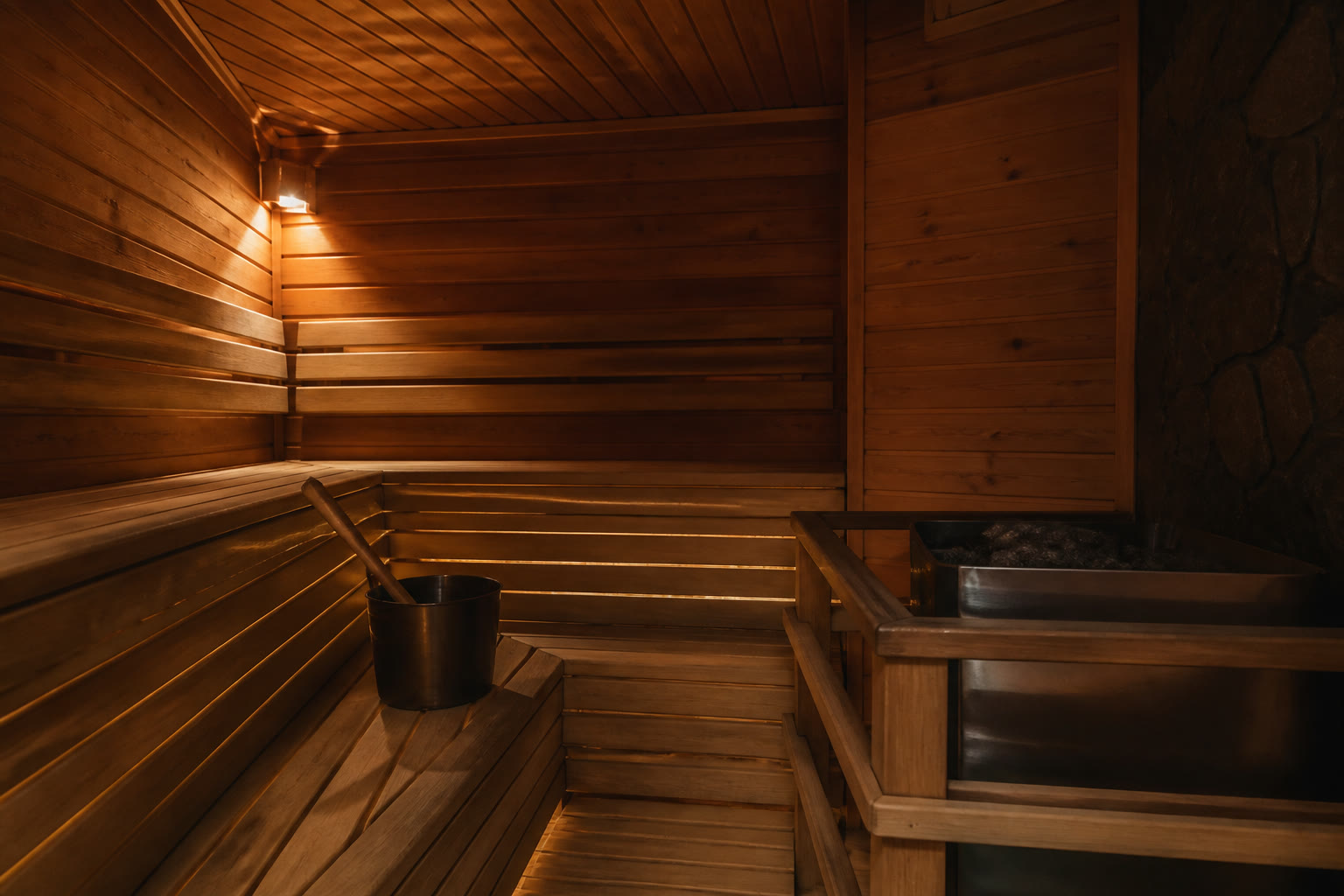
The trials are not that cohort
Brunt 2016 is the heat-therapy trial people want the cabin to be. It is not a Finnish sauna. Twenty young sedentary adults, age 18–30, BMI about 22, not randomly assigned — matched by investigators. Heat: hot-tub immersion 40.5°C, rectal temperature at least 38.5°C for 60 minutes, 4–5 times a week, 8 weeks (36 sessions) versus thermoneutral 36°C sham. n=10 per arm. Flow-mediated dilation 5.6 ± 0.3% → 10.9 ± 1.0%. Aortic pulse-wave velocity 7.1 → 6.1 m/s. Carotid IMT 0.43 → 0.37 mm. Mean arterial pressure 83 ± 1 → 78 ± 2 mmHg. Sham unchanged. Subjects were euhydrated (urine specific gravity under 1.02) and replaced sweat. Authors themselves distinguish this core-temperature stimulus from assuming all sauna types are identical. Not men 45–65. Not CAD. Not a home infrared box.
Debray 2023 is the actual Finnish sauna RCT in this age band, with stable coronary disease. 41 adults, 62 ± 6 years, 33 men and 8 women, heat-naive. Randomised: 8 weeks, 4 sessions a week, 20–30 minutes, 79°C, 13% relative humidity (n=21) versus lifestyle-maintenance control (n=20). Unsupervised. They did heat-acclimate — resting core temperature −0.27°C; sweat rate +0.3 L/h. Change in brachial FMD did not differ (control 0.07% [−0.99, +1.14] versus sauna 0.15% [−0.89, +1.19], interaction P=0.909). Carotid-femoral pulse-wave velocity, SBP, DBP: no between-group difference. Authors: “four sessions of Finnish sauna bathing per week for 8 weeks does not improve markers of vascular health in adults with stable CAD.” Eight weeks of the real room did not move the vessels.
Acute Finnish sauna is a different claim again. Laukkanen 2018, experimental, n=102, mean age 51.9, at least one cardiovascular risk factor: one 30-minute session at 73°C, humidity 10–20%. SBP 137 → 130 mmHg, DBP 82 → 75 immediately after; cf-PWV 9.8 → 8.6 m/s. That is one session, not 8 weeks of remodelling, and not proof of chronic risk reduction.
Heart-failure RCTs exist. They are mostly Waon / far-infrared 60°C, not Finnish 80–100°C. Waon protocol, from Tei 2016: far-infrared dry sauna 60°C, 15 minutes seated, then 30 minutes supine under a blanket; drink water equal to sweat; once daily, 5 days a week, 10 sessions / 2 weeks. Core-temperature rise described as about 1.0–1.2°C. This is not a gym Finnish sauna. WAON-CHF: 19 Japanese hospitals; hospitalised advanced heart failure, BNP >500 on admission and still >300 after at least a week of meds. 76 Waon versus 73 control; mean age 66, 61% men, mean BNP 777 pg/ml, mean LVEF about 30%. Primary endpoint: change in log BNP between groups — not significant (P=0.4179). BNP fell within Waon (P=0.0135), not control. Secondary: 6-minute walk +44.9 versus +12.7 m (P=0.0062); cardiothoracic ratio −1.58 versus −0.28% (P=0.0086); NYHA improved more with Waon. LVEF change 0.87 versus 0.39%, P=0.5765, not significant. SBP unchanged. No deaths. Seven Waon-related minor adverse events: lower BP (2), hypovolemia (2), increased urine, decreased weight, dental bleeding. Not blinded. Cardiac rehab prohibited during the trial. The flagship multicenter RCT missed its primary endpoint.
Källström 2018 searched PubMed, the Cochrane Library and CINAHL for sauna, steam or Waon in heart failure. Nine studies met inclusion; seven in the meta-analysis (491 patients). “Only studies with infrared sauna bath met the inclusion criteria.” Protocol in the pooled trials: 60°C, 15 minutes plus 30 minutes rest, 5×/week, 2–4 weeks. Pooled: BNP mean difference −124.62 pg/ml; EF +1.45%; cardiothoracic ratio −1.82%. SBP and DBP: no significant effect. Authors: this review “cannot show any definite supporting evidence of a positive value of Finnish sauna bathing on HF patients.” Short follow-up; moderate risk of bias; no blinding; largely the same Japanese groups. There is no Cochrane systematic review of sauna or heat therapy for CVD. Källström searched the Cochrane Library; Cheng searched CENTRAL. The Cochrane review in the neighbourhood is exercise training for systolic heart failure, not sauna.
Imamura 2001: 25 men with at least one coronary risk factor, mean age 38, daily 60°C far-infrared, 15 minutes plus 30 minutes blanket, 2 weeks. Healthy controls (n=10) were not treated. %FMD 4.0 ± 1.7 → 5.8 ± 1.3%. Not a randomised sham-controlled trial of a home cabin. Ohori 2012: 41 CHF patients, mean age 68.3, Waon 5×/week for 3 weeks, before–after, no control arm. 6-minute walk 337 → 379 m; FMD 3.5 → 5.5%; LVEF 30.4 → 32.5%; BNP 550 → 416. Useful physiology. Not an RCT.
Pooled RCTs of passive heating do not cleanly reproduce the observational mortality story. Cheng 2025: 20 RCTs, duration 2–15 weeks, interventions mixed — hot water bathing, saunas, hot yoga, local heating. No significant pooled effects on FMD, PWV, resting HR, HRV, fasting glucose, HbA1c, lipids, CRP. Overall SBP −2.46 mmHg (95% CI −5.02 to 0.10); I²=60.3% — not statistically significant. Subgroup: whole-body/systemic heating −4.11 mmHg (−7.36, −0.86); people with coronary risk/CVD −2.52 (−4.26, −0.79). Authors: interpret SBP with caution due to high heterogeneity. Hussain 2018: 40 clinical studies, 3,855 people; only 13 RCTs; most n<40. “Not yet enough evidence to distinguish any particular health differences between repeat Finnish-style and repeat infrared sauna bathing.” These do not confirm KIHD’s 40–50% mortality reductions in trials. They do not show infrared cabins beat Finnish heat.
The cabin is a product claim
Sunlighten’s opened US heart-health page: “Nurture your heart for longevity.” Regular use “can enhance cardiovascular health and impact longevity”; sessions are “passive cardio”; blood flow “5–7 quarts/minute to up to 13 quarts/minute” (Singapore page: 5 to 12 litres/min); “clinically shown” to temporarily lower BP via a 2005 University of Missouri Kansas City SoloCarbon study (30 minutes, 3×/week) — that study was not opened here, so it stays a manufacturer citation. “In Japan, infrared is standard treatment for heart disease” — they then cite Miyata 2008 / Imamura 2001, which are Waon 60°C hospital protocols, not mPulse cabins. Quote on the page (Joel Kahn): “full spectrum infrared sauna therapy would be a multibillion dollar drug if it came in a pill.” A footer that “statements have not been evaluated” is not on the hero longevity copy. That page does not show their cabin was the intervention in Laukkanen 2015 or Tei 2016. “Passive cardio” is marketing language, not an AHA exercise equivalent.
FDA has already treated disease claims on an infrared sauna as a problem. Class 2 Device Recall, Portable FAR Infrared Sauna (Therasage, LLC), recall Z-1541-2015: marketed with indications including “Heart Health, Cancer Therapy, Lyme Disease” plus pain and anxiety. Distributed without 510(k). Cause: “Labeling False and Misleading.” Firm told consignees to discard claims including “naturally detoxify,” “expels toxins,” exact calorie burn, “negative ion therapy.” Quantity in commerce: 8 devices. This is a labelling enforcement example, not a trial, and it does not mean every cabin is illegal. It means disease claims without clearance get struck. No opened FDA page approves a consumer infrared sauna to treat heart failure, coronary disease, or aging. 21 CFR 890.5500 classifies infrared lamps intended for medical purposes — not a clearance of consumer cabins as CVD drugs.
Do you need to buy anything
No. For a man 45–65 with stable blood pressure or stable coronary disease, who already has access to a traditional dry sauna — gym, spa, club — using it as a habit, sitting, hydrating, cooling down seated, no alcohol, is compatible with the safety literature and with an associational signal in Finns. It is not a replacement for walking, blood-pressure tablets, or sleep. I am not going to put a $4,000 affiliate box next to JAMA Internal Medicine 2015 as if the DOI were a SKU. I am not going to sell a home infrared cabin as “the Laukkanen protocol,” “Waon therapy,” or “passive cardio equal to exercise.” Different heat, different patients, different designs. WAON-CHF missed its primary endpoint. Debray says 8 weeks of real Finnish sauna did not move FMD or blood pressure in stable CAD.
Hydrate to replace sweat. Skip the session if you are febrile, lightheaded, or coming off alcohol. If you are on antihypertensives, diuretics or nitrates: a physician, and do not stack a nitro patch with a long hot round.
When this is not the article
Hannuksela 2001, from the opened abstract: contraindications include unstable angina pectoris, recent myocardial infarction, and severe aortic stenosis. “Safe for most people with coronary heart disease with stable angina or old MI.” “Very few acute MIs and sudden deaths occur in saunas, but alcohol consumption during sauna bathing increases the risk of hypotension, arrhythmia, and sudden death, and should be avoided.” Kukkonen-Harjula 2006, opened full review of Finnish and German experiments, 80–90°C rooms, 5–20 minutes, 1–3 rounds: heart rate up to about 2× resting; cardiac output about +70%; total peripheral resistance about −40%; diastolic and MAP fall; systolic often little changed during heat. Sweat about 0.5–1 kg; “water should be replenished by drinking during, or after.” Sudden death risk small but rises with age in 1970s Finnish data: men over 60, 1 per 0.4 million baths; 50–59, 1 per 2.3 million; 40–49, 1 per 9 million. Alcohol contributes to accidents, burns, drowning and hypotension. Contraindications listed: prolonged or unstable angina-type chest pain; MI or other severe cardiac event for 4–8 weeks; severe orthostatic hypotension; severe aortic stenosis; fever or acute infection; acute inflammatory rheumatoid arthritis; some skin conditions. Antihypertensives immediately before bathing “not advisable” because they amplify post-sauna hypotensive effects. Nitroglycerin patches: sauna can increase absorption. Insulin absorption from subcutaneous injection enhanced during bathing. Stable, medicated hypertension, CAD, compensated heart failure: baths “did not appear to be particularly risky.” Most data are uncontrolled and in sauna-habituated Finns. Unaccustomed older US men with new cabins are not that sample.
Laukkanen 2015: people prone to orthostatic hypotension should be cautious; the blood-pressure drop typically occurs immediately after sauna. “Only 1% to 2% of sudden deaths occurred within 24 hours of sauna bathing … alcohol intake together with sauna bathing has been a major contributing factor.” An AHA 2026 scientific statement on nonoptimal temperature is about ambient climate heat and cold, not sauna as therapy. I am not going to quote it as a spa endorsement.
Dizziness is not a badge. Unstable angina, recent MI, decompensated heart failure, severe aortic stenosis: see a clinician, do not sit in a hot room because an article had a hazard ratio in it. I am not in a position to clear you for heat.
How I checked this
Kin reviewed 2 September 2026, against the primary records rather than summaries of them. Nothing here about the body was written before that review, and where Kin's ruling and a seller's claim disagree, Kin wins.
- Established evidence Laukkanen T, Khan H, Zaccardi F, Laukkanen JA. Association between sauna bathing and fatal cardiovascular and all-cause mortality events. JAMA Intern Med. 2015;175(4):542–548 — doi:10.1001/jamainternmed.2014.8187, JAMA Network. Observational; 2,315 Finnish men 42–60; reference is 1×/week, not never. 2–3× SCD HR 0.78 (0.57–1.07), P=.12 after full adjustment. 4–7× n=201, 10 SCD events.
- Established evidence Same KIHD culture, still observational. Zaccardi F et al. incident hypertension, Am J Hypertens. 2017;30(11):1120–1125 — doi:10.1093/ajh/hpx102 (2–3× fully adjusted NS). Kunutsor SK et al. stroke, Neurology. 2018;90(22):e1937–e1944 — doi:10.1212/WNL.0000000000005606. Laukkanen T et al. dementia, Age Ageing. 2017;46(2):245–249 — doi:10.1093/ageing/afw212 (2–3× intervals include 1.0). Laukkanen JA et al. fitness + sauna and SCD, Prog Cardiovasc Dis. 2018 — doi:10.1016/j.pcad.2018.03.005 (low CRF + high sauna HR 0.71, 0.45–1.10).
- Early research Brunt VE et al. Passive heat therapy (hot-tub, not Finnish sauna) in sedentary 18–30-year-olds. J Physiol. 2016;594(18):5329–5342 — doi:10.1113/JP272453, NCT02518399. n=10 per arm, matched not randomised. Debray A et al. Finnish sauna RCT in stable CAD, age 62 ± 6. J Appl Physiol. 2023 — doi:10.1152/japplphysiol.00322.2023, NCT03620539. 8 weeks, 4×/week, 79°C: FMD/PWV/BP null. Laukkanen T et al. acute 30 min at 73°C, n=102, mean age 51.9. J Hum Hypertens. 2018;32:129–138 — doi:10.1038/s41371-017-0008-z.
- Early research Tei C et al. WAON-CHF. Circ J. 2016;80:827–834 — doi:10.1253/circj.CJ-16-0051, PDF. 60°C far-infrared + blanket, hospital inpatients. Primary log-BNP between groups P=0.4179 (missed). Källström M et al. Clin Cardiol. 2018;41:1491–1501 — doi:10.1002/clc.23077, PMC6489706: only infrared met inclusion; no Finnish-sauna HF trials. Imamura M et al. J Am Coll Cardiol. 2001;38(4):1083–1088 — doi:10.1016/S0735-1097(01)01467-X. Ohori T et al. Am J Cardiol. 2012;109:100–104 — doi:10.1016/j.amjcard.2011.08.011 (before–after, not RCT).
- Early research Cheng JL, MacDonald MJ. Passive heating RCTs, Am J Prev Cardiol. 2025 — doi:10.1016/j.ajpc.2025.101082, PMID 41049507, PubMed, PROSPERO CRD42024621600. 20 RCTs; overall SBP −2.46 mmHg, NS. Hussain J, Cohen M. Evid Based Complement Alternat Med. 2018;2018:1857413 — doi:10.1155/2018/1857413, PMC5941775 (Cochrane risk-of-bias method, not a Cochrane review). No Cochrane sauna-for-CVD review was found.
- Seller's claim Sunlighten heart-health pages: US, SG/EN — “passive cardio,” “longevity,” “clinically shown”; 2005 UMKC SoloCarbon study not opened. FDA Class 2 recall Z-1541-2015, Therasage Portable FAR Infrared Sauna, labeling false and misleading, including heart-health claims — FDA recall.
- Established evidence Hannuksela ML, Ellahham S. Benefits and risks of sauna bathing. Am J Med. 2001;110(2):118–126 — doi:10.1016/S0002-9343(00)00671-9 (abstract opened: unstable angina, recent MI, severe AS; alcohol). Kukkonen-Harjula K, Kauppinen K. Int J Circumpolar Health. 2006;65(3):195–205 — doi:10.3402/ijch.v65i3.18102. AHA 2026 statement on nonoptimal temperature is ambient climate, not sauna therapy — doi:10.1161/CIR.0000000000001419, AHA.
What I don't know: whether sauna causes fewer deaths. KIHD cannot kill residual confounding; never-users were excluded; the 4–7× cell is tiny. There is no opened RCT that a home infrared cabin replicates Laukkanen 2015 or WAON-CHF. The 2005 UMKC SoloCarbon study on the Sunlighten page was not opened. Hard-outcome RCTs of “drink X glasses” do not exist; hydration advice is physiology plus forensic alcohol risk, not a trial. Kihara 2009’s 5-year cardiac-event claim is a matched retrospective, not the 2016 RCT, and is not used as proof here.