Getting back into it
Powder is a tool for a gap. It is not dinner, and 200 grams is not in any guideline Kin opened.
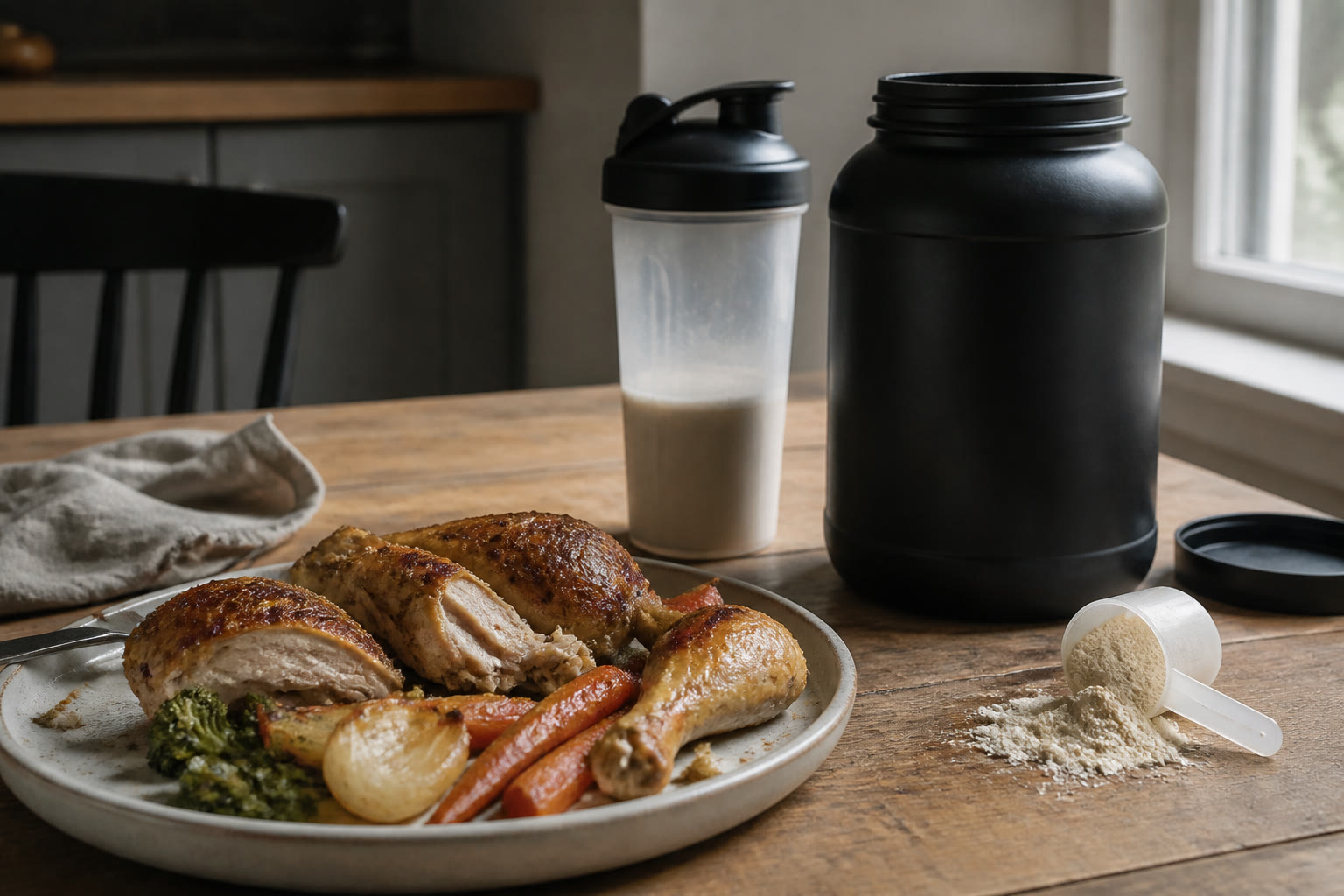
Count the plate first. If appetite, teeth or a lousy lunch are why you are short, one scoop of a complete protein is a tool. A third shake because the tub looked serious is a different product.
The fight is powder as a practical way to close a protein gap when appetite, teeth or cooking fail versus replacing meals with shakes, or chasing 200 g because the tub implied more.
For men in this age band, 0.8 g per kilogram per day is a deficiency floor, not an older-adult target. It is the number WHO, IOM 2005 and EFSA wrote for adults of all ages. The geriatric documents Kin opened sit higher. Not 1.6 as a universal must. Not 0.8 as enough.
PROT-AGE, Bauer and colleagues, 2013, older people over 65: existing guidelines specify the same RDA for all adults, 0.8 g/kg body weight/day; the working group says that is too low. Average daily intake at least in the range of 1.0 to 1.2 g protein per kilogram of body weight per day to maintain or regain lean mass and function. Higher protein, at least 1.2 g/kg/day, for those exercising and otherwise active. Most with acute or chronic disease: 1.2–1.5 g/kg/day. Severe illness, injury or marked malnutrition: as much as 2.0 g/kg/day.
ESPEN Expert Group, Deutz and colleagues, 2014: (a) healthy older people at least 1.0–1.2 g/kg/day; (b) malnourished or at risk because of acute or chronic illness 1.2–1.5 g/kg/day, higher with severe illness or injury; (c) daily physical activity and exercise for as long as possible. They note the RDA has traditionally been 0.8 g/kg/day for healthy adults of all ages.
ESPEN geriatrics guideline, Volkert and colleagues, 2019, Recommendation 2, Grade B, 100% agreement: protein intake in older persons “should be at least 1 g protein per kg body weight and day,” individually adjusted for nutritional status, physical activity, disease and tolerance. Commentary: several expert groups have suggested 1.0–1.2 g/kg for healthy older persons; 1.2–1.5 g/kg with acute or chronic illness; up to 2.0 g/kg in severe illness, injury or malnutrition; “until more evidence is available, an intake of at least 1.0 g/kg should be ensured in all older persons.” Volkert also: “very little is known about the protein needs of frail and ill older persons, and scientific evidence… is presently insufficient to derive concrete figures” beyond the at-least-1.0 floor.
None of those three documents sets 1.2–1.6 g/kg as a single official range, or 200 g/day as a target. They do not say every 55-year-old must hit 1.6. They do not say 0.8 g/kg maintains muscle in older adults. PROT-AGE says protein quality, timing and other supplements “may be relevant, but evidence is not yet sufficient to support specific recommendations.” Two different “right” numbers, honestly held: IOM/WHO 0.8 versus PROT-AGE/ESPEN 1.0–1.2 (and 1.2–1.5 if ill) versus ISSN 1.4–2.0 for exercising people versus Morton’s about 1.6 g/kg RET-FFM plateau. I am not going to collapse them into one influencer range. The 1.2–1.6 band is a mash-up, not a sentence any one opened guideline wrote.
Per-meal dose, not a blender total, is the mechanistic lever. Opened papers put an older-adult meal in the 25–40 g high-quality protein range, with leucine in the low grams. Not as much powder as fits.
PROT-AGE boxed recommendation: “The per-meal anabolic threshold of dietary protein/amino acid intake is higher in older individuals (ie, 25 to 30 g protein per meal, containing about 2.5 to 2.8 g leucine) in comparison with young adults.” They also note debate about even distribution versus pulse feeding — one large midday protein meal — and call for more trials. Pulse versus spreading is unresolved inside PROT-AGE itself. PROT-AGE does not lock in 40 g as mandatory. Long-term leucine-alone trials they cite did not increase muscle mass or strength. Leucine 2.5–2.8 g is a meal-composition target, not a leucine-pill protocol.
ISSN position stand, Jäger and colleagues, 2017, written for healthy exercising individuals and athletes, not as a PROT-AGE replacement: general per-serving recommendations 0.25 g high-quality protein per kg, or an absolute dose of 20–40 g; acute doses should strive to contain 700–3000 mg leucine plus a balanced array of essential amino acids; doses ideally every 3–4 hours. ISSN separately: “Higher doses (~40 g) are likely needed to maximise MPS responses in elderly individuals,” citing Yang. ESPEN Deutz Table 2 on Yang 2012: older adults, n=10, age 79±4, ingested 0, 10, 20 and 40 g whey after resistance exercise; “in contrast to younger adults, in whom post-exercise rates of muscle protein synthesis are maximised with 20 g of protein, exercised muscles of older adults respond to higher protein doses of 20 and 40 g protein.” That is an acute MPS dose-response in ten older men, not a 12-week hypertrophy trial proving 40 g scoops beat 25 g meals. Oikawa cites Moore 2015: older men needed about 40% more isolated high-quality whey per meal than younger men for a comparable MPS response.
None of these papers says a third shake is required if breakfast and dinner already hold 25–30 g.
Food first. Powder, or a medical-style oral nutritional supplement, is a tool when intake from food is failing — appetite, chewing, shopping and cooking, illness — not a lifestyle of liquid meals.
ESPEN Deutz: older adults usually eat less, including less protein; up to 10% of community-dwelling and 35% of institutional older adults in Europe fail to meet the estimated average requirement (0.7 g/kg/day). Reasons listed include low appetite, medical anorexia, physical and mental disability that limit shopping and food preparation, food insecurity, and poor dentition that limits chewing and protein availability. PROT-AGE: inadequate intake (anorexia and appetite loss, GI disturbances), reduced ability to use protein, or greater need.
Volkert: oral options first. Individualised nutritional counselling (Rec 18). Fortified food (Rec 20). Additional snacks and/or finger food (Rec 21). Texture-modified, enriched foods for dysphagia and chewing problems (Rec 22). Oral nutritional supplements when dietary counselling and food fortification are not sufficient to increase intake and reach goals (Rec 24, GPP); hospitalised older persons with malnutrition or risk shall be offered ONS (Rec 23, Grade A). Rec 27: ONS shall provide at least 400 kcal/day including 30 g or more of protein/day — that is a medical ONS spec, not a gym-tub serving. Rec 11: dietary restrictions that may limit intake should be avoided. ESPEN and Volkert do not recommend replacing meals with shakes in community-dwelling men who can still eat. Volkert’s Grade A ONS evidence is hospitalised, malnourished, post-discharge older patients, often medical ONS, not Gold Standard after a 5 p.m. commute.
ISSN point 8: “While it is possible for physically active individuals to obtain their daily protein requirements through the consumption of whole foods, supplementation is a practical way of ensuring intake of adequate protein quality and quantity, while minimising caloric intake, particularly for athletes who typically complete high volumes of training.” Point 11: athletes should consider focusing on whole-food sources that contain all essential amino acids. That “practical supplementation” line is written around athletes minimising calories, not around a 55-year-old meal replacement.
Optimum Nutrition Gold Standard 100% Whey, opened for scoop size, not efficacy, NIH ODS Dietary Supplement Label Database: serving size 1 rounded scoop (31.5 g); protein 24 g. Directions: mix one scoop in 6–8 oz liquid. “NOTICE: USE THIS PRODUCT AS A FOOD SUPPLEMENT ONLY. DO NOT USE FOR WEIGHT REDUCTION.” “SUGGESTED USE: Consume enough protein to meet your daily protein requirements through a combination of high protein foods and protein supplements.” The panel does not prescribe two or three scoops, 200 g/day, or “replace dinner.” A 24 g scoop is a typical serving size, not an efficacy finding. Other tubs differ. Use the Supplement Facts on the actual product. I am not inventing a universal 30 g scoop.
Extra protein helps most when it is closing a gap next to resistance work. Chasing intake past about 1.6 g/kg/day has not been shown to buy more training-induced lean mass in the meta that tested that breakpoint — and the supplement effect shrinks with age.
Morton, Murphy, McKellar and colleagues, 2018: Kin opened the published abstract. Full PMC HTML was blocked by captcha and timeout. Forty-nine RCTs, 1,863 participants, resistance exercise training at least 6 weeks plus protein supplement. Protein supplementation increased 1-RM by 2.49 kg (95% CI 0.64–4.33), fat-free mass by 0.30 kg (0.09–0.52), and muscle size. “The impact of protein supplementation on gains in FFM was reduced with increasing age (−0.01 kg (−0.02, −0.00), p=0.002)” and was larger in resistance-trained individuals. “Protein supplementation beyond total protein intakes of 1.62 g/kg/day resulted in no further RET-induced gains in FFM.” Conclusion: “protein intakes at amounts greater than ~1.6 g/kg/day do not further contribute RET-induced gains in FFM.” Mixed-age healthy adults, not a men-45–65-only trial. The FFM increment is 0.30 kg — real, small. 1.62 g/kg/day is a breakpoint for RET-induced FFM in that meta, not a geriatric society target and not a 200 g/day prescription. For a 90 kg man, 1.6 g/kg is about 144 g. Age reduced the supplement effect. It does not say older men should therefore drink more shakes to compensate.
PROT-AGE on Cermak 2012: 22 RCTs, 680 young and old subjects, resistance training more than 6 weeks plus protein co-ingestion — significant muscle-mass gains associated with strength gains. PROT-AGE on Tieland: frail older people, resistance training twice weekly for 24 weeks, 15 g protein supplement twice daily versus placebo — significant muscle hypertrophy plus strength and performance; authors concluded protein intake was necessary for training-associated gains in muscle mass. A separate Tieland protein-only arm (15 g at breakfast plus 15 g at lunch, 24 weeks, no resistance-training requirement in that report as summarised by PROT-AGE) improved strength and function without measurable muscle-mass change. ESPEN Deutz Table 2 on Tieland: “Prolonged resistance-type exercise training improved strength and physical performance in frail elderly people. Dietary protein supplementation is required to allow muscle mass gain during such exercise training.” Tieland is frail elderly, mixed sex, 15 g twice daily — not three 40 g scoops.
Health ABC as used by PROT-AGE (Houston 2008, observational, n=2,066, ages 70–79): after confounder adjustment, the highest quintile of energy-adjusted protein intake lost approximately 40% less lean body mass over 3 years than the lowest quintile. Food-frequency observation, not a powder RCT, cannot prove causality. PROT-AGE says so. None of these papers tests “replace dinner with a shake.”
200 g/day: no opened guideline, ISSN stand, or Morton breakpoint equals 200 g. For a 90 kg man, PROT-AGE healthy 1.0–1.2 is about 90–108 g; exercising at least 1.2 is about 108 g and up; Morton plateau about 144 g; ISSN athlete 1.4–2.0 is about 126–180 g. 200 g is tub culture.
Whey and casein are complete, leucine-bearing milk proteins with different digestion speeds. Collagen is sold as “protein” but, in the opened RCT, it does not do the muscle-protein job whey does.
Oikawa 2020: double-blind parallel RCT, 22 healthy older women, mean age 69±3, 30 g amino acids twice daily of whey isolate versus hydrolysed collagen peptides for 6 days, unilateral resistance exercise. Per serving, manufacturer amino-acid table: whey essential amino acids 15.4 g versus collagen 5.6 g; leucine 4.3 g versus 0.9 g; tryptophan 0.7 g versus 0. Authors: whey DIAAS 1.09; collagen DIAAS 0 because it lacks tryptophan. Acute myofibrillar muscle protein synthesis rose with whey in the feeding-only and feeding-plus-exercise legs; collagen raised acute MPS only with exercise, and less than whey. Over 6 days, integrated MPS rose with whey (rest and exercise) and was not significantly elevated above baseline with collagen in rest or exercise. Authors: “WP is a more effective supplement to support skeletal muscle retention in older women than CP.” They state there is “no support” for amino-acid or peptide-based mechanisms that ostensibly underpinned previously reported collagen-plus-resistance-training lean-mass gains (Zdzieblik), and they cite Phillips questioning those gains.
Oikawa is 6 days of MPS in healthy older women, not a 12-week hypertrophy trial in men 45–65, and not a ban on collagen for skin or joint questions. Those outcomes were not the primary. DIAAS 0 is about indispensable amino-acid completeness for muscle protein, not “collagen is fake protein” in a chemical sense. I am not extending Oikawa to “collagen does nothing for tendons.” That was not studied as primary.
PROT-AGE and ESPEN: whey is a “fast” protein, casein “slow”; several acute studies found whey stimulated postprandial muscle protein accretion more than casein in older men; after resistance exercise some studies found whey and casein equally increased synthesis depending on casein form (micellar versus caseinate). PROT-AGE says evidence is not yet sufficient for a specific always-whey, never-casein recommendation. ISSN: rapidly digested proteins with high essential amino acids and adequate leucine are most effective at stimulating MPS; whey often outperformed casein and soy in acute MPS comparisons; fast versus slow still matters for the muscle, not just whole-body leucine balance. ISSN does not say casein is useless; it cites 30–40 g pre-sleep casein for overnight MPS in other populations.
Kidney caution is a guideline exception, not gym lore. High protein is not the default in chronic kidney disease. Healthy older kidneys are a different sentence.
PROT-AGE: older people with severe kidney disease (estimated GFR below 30 mL/min/1.73 m²) who are not on dialysis “are an exception to the high-protein rule; these individuals need to limit protein intake.” Table 6: severe CKD, GFR below 30: limit to 0.8 g/kg ideal body weight/day; moderate CKD 30 to below 60: 0.8 g/kg is safe but monitor GFR twice yearly; mild CKD, GFR above 60: increase protein per patient needs. Dialysis: more than 1.2 g/kg, or 1.5 if achievable. They state reviews find little or no evidence that high-protein diets cause kidney damage in healthy individuals, including older people, and that 1.0–1.2 g/kg is expected to maintain nitrogen balance without affecting renal function pending more studies.
ESPEN Deutz: in older adults with healthy kidneys or only mild dysfunction, “standard protein intake is safe.” Moderately impaired GFR: physician judgement. Severe CKD: usual recommendation 0.6–0.8 g/kg/day with sufficient energy (about 30 kcal/kg/day); palliative multi-morbid patients may be excepted because short-term protein-energy wasting risk can outweigh long-term renal risk. Serum creatinine and eGFR interpretation in low-muscle older adults is flagged by ESPEN as easy to misclassify. That is a reason to involve a clinician, not to self-dose.
KDIGO 2024, Recommendation 3.3.1.1: “We suggest maintaining a protein intake of 0.8 g/kg body weight/d in adults with CKD G3–G5 (2C).” Practice Point 3.3.1.1: avoid high protein intake (above 1.3 g/kg/day) in adults with CKD at risk of progression. Practice Point 3.3.1.3: do not prescribe low or very-low protein diets in metabolically unstable people with CKD. Practice Point 3.3.1.5, older adults: “In older adults with underlying conditions such as frailty and sarcopenia, consider higher protein and calorie dietary targets.” Practice Point 3.3.1: plant-forward diverse diet, fewer ultraprocessed foods; use a renal dietitian. KDIGO 0.8 g/kg in G3–G5 is a CKD guideline, not a reason for a healthy 55-year-old to stay at the RDA. “Consider higher protein” in frail or sarcopenic older adults is a practice point, not a green light for 2 g/kg in undiagnosed reduced GFR. PROT-AGE and ESPEN do not say high protein causes CKD in healthy men. None of these pages says drink a third shake, your kidneys will adapt.
Protein powder is a dietary supplement, not a drug. Labels may talk structure/function — “protein helps maintain muscle.” They may not claim to diagnose, treat, cure or prevent sarcopenia, CKD or frailty. FDA does not pre-approve the tub.
DSHEA, as described on the opened FDA structure/function page: those claims may describe a nutrient’s role in normal structure or function (FDA’s example: “calcium builds strong bones”) or the means of maintaining it. They are not pre-approved by FDA. The manufacturer must have substantiation that the claim is truthful and not misleading, and must notify FDA no later than 30 days after marketing the claim. If the label includes such a claim, it must carry a disclaimer that FDA has not evaluated the claim and that the product is not intended to diagnose, treat, cure or prevent any disease, because only a drug can legally make that claim. Dietary supplements are regulated under a different set of rules than drugs; manufacturers are responsible for safety and labelling before marketing; FDA’s enforcement authority is after the product is on the market (adulterated or misbranded). A structure/function sentence is not an ESPEN recommendation. FDA does not certify that a whey tub builds muscle, reverses sarcopenia, or is clinically proven for men over 50.
Third-party testing is a manufacturing and contaminant process: label match, heavy metals, microbes; for sport programmes also banned-substance screens. It is not a ranking of which powder puts on the most muscle, and it is not FDA approval. NSF Certified for Sport, opened page: reports that some products do not contain the ingredients or quantities on the label, or are adulterated, are why an independent standard exists (NSF/ANSI 173). Certified for Sport verifies that products “do not contain unsafe levels of contaminants, prohibited substances or masking agents, and that what is on the label matches what is in the product.” Quality components listed: no 290 substances banned by major athletic organisations; contents match the label; no unsafe levels of contaminants; manufactured at a GMP-certified facility audited annually or bi-annually by NSF. The mark is recognised by USADA and several pro leagues as a banned-substance programme. It is a lot and facility process, not an efficacy trial. NSF does not say Certified for Sport whey outperforms uncertified whey for MPS or lean mass. USP.org Verified Mark live page returned 500 / Access Denied on this pass. I am not ranking USP versus NSF as better muscle, and I am not inventing USP contaminant lists from memory. No opened survey quantifying heavy-metal rates in protein powders is in this brief. I am not citing a viral metals chart that was not opened.
Conflicts I would rather print than sand off. ISSN authors include industry-linked sports-nutrition researchers. PROT-AGE meeting funded via an EUGMS grant from Nestlé Nutrition; several authors report speaker and research ties to nutrition companies, listed on the PDF. Report the numbers. Do not launder them as disinterested. NIH ODS Exercise and Athletic Performance fact sheet timed out on this pass. I am not inventing ODS gram numbers.
Count food first. For a man 45–65, apparently healthy kidneys, the opened geriatric target is at least 1.0–1.2 g/kg/day (PROT-AGE/ESPEN), not 0.8. If he lifts, PROT-AGE says at least 1.2. Put 25–30 g high-quality protein — about 2.5–2.8 g leucine — at meals he actually eats. Eggs, dairy, fish, meat, Greek yogurt, before adding powder.
If appetite, teeth, cooking, or a lousy lunch are why he is short, one scoop of a complete protein (opened typical: about 24 g whey in about 31.5 g powder) mixed in water or milk is a tool to hit the gap. That is what “supplement” means on the ON panel. Texture-modified food and fortification are the clinical first cousins (Volkert). Pair extra protein with resistance work. Tieland, Cermak, PROT-AGE: the mass gain story is protein plus loading the muscle, not the blender alone. Prefer whey or casein, or food that already is those proteins, when the job is muscle. Collagen is not a complete muscle protein in the opened RCT.
If he has CKD, reduced eGFR, or does not know his GFR: KDIGO 0.8 g/kg in G3–G5 and avoid above 1.3 until a clinician or renal dietitian owns the number. PROT-AGE already carves out GFR below 30 not on dialysis. Look for a third-party tested product as a process (NSF Certified for Sport: label match, contaminants, GMP). That is quality control, not hypertrophy.
What I will not dress up. Replacing dinner with a shake for convenience in a man who can still chew and cook. Volkert is food-first; the ON label itself says food supplement, not weight-reduction or meal replacement. A third shake because the serving directions were silent and the tub looked serious. Morton’s opened abstract: past about 1.6 g/kg/day, no further RET-induced FFM. 200 g/day is not in PROT-AGE, ESPEN, ISSN or KDIGO. Collagen as the muscle powder. High protein wrecks healthy kidneys, as a universal scare — or high protein is kidney-safe in CKD, as a universal flex. Both are false on the opened guidelines. Disease claims: treats sarcopenia, prevents frailty, heals joints, FDA-approved muscle builder. Ranking tubs by influencer recipes, dirty-bulk 200 g plans, or NSF as if it were a hypertrophy leaderboard.
Not if the plate already holds 25–30 g at the meals you eat and the day lands at 1.0–1.2 g/kg, or at least 1.2 if you lift. If it does not, and the reason is appetite, teeth or a lunch you cannot cook, one scoop of a complete, third-party-tested whey or casein is a reasonable tool. I am not ranking brands, I am not pasting a fake affiliate URL, and I am not going to tell you the tub is dinner.
If you have known chronic kidney disease, an eGFR you do not understand, unexplained weight loss, a swallowing problem, or someone has sold you a powder as a treatment for sarcopenia or frailty, that is a clinician and, for CKD, a renal dietitian. I am not in a position to diagnose you. eGFR in a low-muscle older adult is easy to misclassify. That is ESPEN’s flag, not a vibe.
The claims in this piece were reviewed by Kin on 2 September 2026, against the primary records rather than summaries of them. Nothing here about the body was written before that review, and where Kin's ruling and a seller's claim disagree, Kin wins.
What I don't know: whether one scoop versus food fortification versus nothing changes 12-week lean mass in community men 45–65 who still cook. That trial was not opened. Morton is an abstract. Oikawa is 6 days in older women. Houston is observational in 70-year-olds. USP was blocked. No heavy-metal survey of powders was opened. I can tell you what the geriatric targets and the ON panel actually say. That is a smaller claim.