Getting back into it
A sleeve can make a squat you already tolerate feel better. It is not how you justify a squat the joint cannot do, and it is not a hinged unloader.
Wear them if they make a tolerable squat more comfortable. Take them off if they are how you justify a squat that is not.
The fight is compression, warmth and feeling the knee versus wearing competition sleeves as a placebo costume that does not treat osteoarthritis and does not replace training the knees can tolerate.
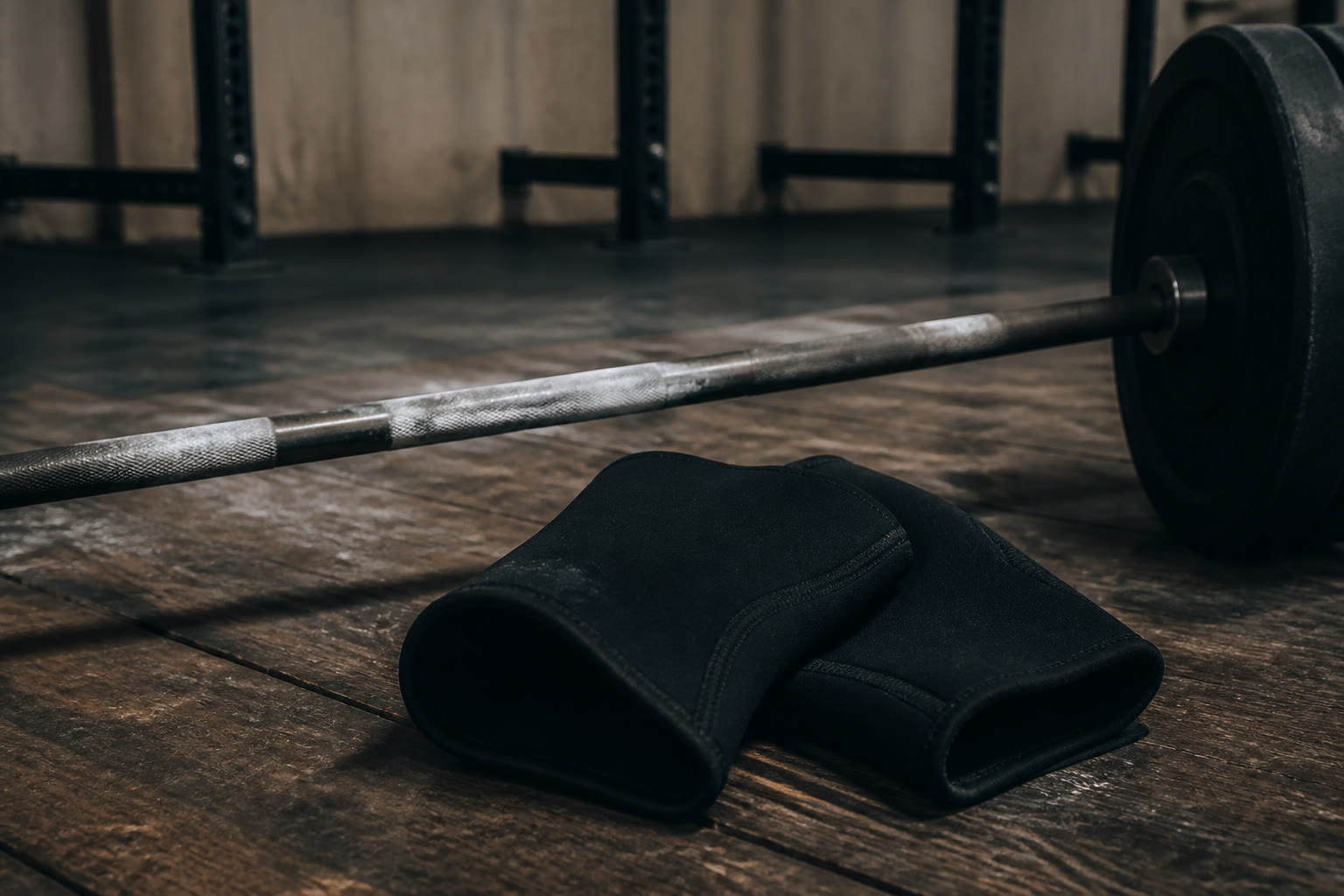
A competition knee sleeve is a single-ply neoprene cylinder. IPF Technical Rules, effective 1 March 2026, sections 3.8–3.9: continuous neoprene, maximum 7 mm thick and 30 cm long, no Velcro, no strapping, no padding. “The entire construction of the sleeves may not be such as to provide any appreciable support or rebound to the lifter’s knees.” A wrap is a 2 m by 8 cm elastic bandage wound tight, equipped lifting only. Sleeve plus wrap together is forbidden. An unloader is a hinged orthosis that applies a valgus or varus moment. Those are classification facts, not a marketing vibe.
SBD’s Classic Training Knee Sleeves page: “7 mm high grade neoprene for maximal support,” “designed to aid performance,” IPF approved, 30 cm length. That is a product page, not a trial. Rehband RX Original V 7 mm: “firm compression, warmth and stability”; “Sharpens your sense of joint position and control under load”; “Adds confidence under the bar.” Marketing copy. The IPF rulebook forbids appreciable support or rebound. SBD sells maximal support. Both can be true only if “support” means compression and warmth, not a brace. IPF approval is not a medical indication.
FDA: a limb orthosis is “worn on the upper or lower extremities to support, to correct, or to prevent deformities” (21 CFR 890.3475, product code ITQ). Class I, 510(k) exempt, GMP-exempt except records and complaints. Historic 510(k) K812423 is a 1981 “NEOPRENE KNEE SUPPORT.” Modern sleeves generally sit in the same Class I bucket. Listing a device as ITQ is registration, not an efficacy trial, and not a finding that a 7 mm sleeve treats OA.
Elastic and neoprene sleeves — soft braces — produce modest, mostly immediate pain and function gains in knee osteoarthritis. Effects are small, often lab-only, and fade or fail to beat standard care over weeks. They are not a disease treatment. They do not slow cartilage loss, change Kellgren–Lawrence grade, or replace exercise and weight loss. The devices in this literature are almost never IPF 7 mm lifting sleeves.
Cudejko 2018 meta-analysis, 11 studies (6 RCTs, 5 non-RCTs; RCT quality rated low): moderate immediate within-group pain improvement for wearing a soft brace versus not, SMD 0.52 (95% CI 0.14–0.89; 284 people); versus standard care, a moderate prolonged pain effect, SMD 0.61 (0.33–0.89; 206 people), plus small-to-moderate self-reported function, SMD 0.39 (0.11–0.67). Cudejko 2017 is a single-session lab study, n=44, mean age 65.7, Genutex A2 elastic brace, not a 7 mm lifting sleeve. Treadmill NRS pain down 0.6 points walking and 0.8 points with perturbations — near the about-1-point NRS MCID they cite, not clearly over it. Tight versus non-tight barely differed. Authors state they cannot generalise to daily life and list placebo as a plausible mechanism.
Pajareya 2003: daytime elastic sleeve plus usual meds versus meds/education. Extra 1.63 s improvement in aggregated functional performance time immediately (95% CI 0.21–3.05). No between-group difference at week 8. Ayık 2025, n=60, mean age 61: both a plain neoprene sleeve and one with four metal stays improved acute balance and VAS; between-group Berg Balance Scale p=0.056; no long-term follow-up.
Expect thin. Soft-brace RCTs are small, often unblinded — you can feel a sleeve — immediate or eight to twelve weeks, mixed devices (tubigrip, GenuTrain, Genutex, generic neoprene, heat-retaining fabric). That is not a licence to transplant any of it onto a 55-year-old medial OA knee under a barbell.
Custom valgus “unloader” braces — hinged, three-point or similar — outperform neoprene sleeves for medial and varus OA pain after walking and stairs. That still is not a slam dunk, and it is not a 7 mm SBD.
Kirkley 1999 randomised 119 people with varus gonarthrosis, mean ages about 58–61, to medical care, medical care plus a neoprene sleeve, or medical care plus a custom valgus unloader. At 6 months both brace arms beat control on disease-specific quality of life (p=0.001) and function (p≤0.001). Unloader beat sleeve on pain after the 6-minute walk (p=0.021) and the 30-second stair climb (p=0.016). WOMAC aggregate was only a trend (p=0.062). Cochrane could not pool Kirkley (means without SDs). It is still the main head-to-head of sleeve versus unloader.
Cochrane 2015, Duivenvoorden, 13 studies, n=1,356, search to March 2014: could not pool most brace trials. The one 12-month brace-versus-no-brace analysis (Brouwer 2006, n=117) showed no difference in VAS pain (MD 0.0, 95% CI −0.84 to 0.84), function or quality of life. 24 of 60 brace users versus 14 of 57 controls stopped, mostly for lack of effect; skin irritation and poor fit occurred. Authors: “low-quality inconclusive evidence.” Cochrane does not endorse wear-a-brace-and-skip-the-squat.
PROP OA, Holden and colleagues, BMJ 2026, n=466, mean age 64: adding a patellofemoral, tibiofemoral unloading, or neutral stabilising brace plus adherence support to advice and exercise improved KOOS-5 at 6 months by 3.39 points (95% CI 0.96–5.82; effect size 0.24); KOOS pain +6.13 (ES 0.39). Twelve-month KOOS-5 not significant (2.67, 95% CI −0.24 to 5.57). Adverse events minor. This is compartment-specific braces, not sleeves. It does not rescue the 7 mm costume. Gohal 2018 systematic review: unloaders more often beat neoprene sleeves for pain; function and stiffness mixed; many trials tiny.
Neoprene sleeves add a few pounds to squat 1RM in young trained men versus a flimsy control sleeve. They do not improve jump, velocity, or isolation endurance. Knee wraps store and return elastic energy, change squat mechanics, and can cut muscle force integrals. Sleeves mostly change how the set feels.
Machek 2021: n=15 resistance-trained men, mean age 22.1, sleeve-naive. Crossover: control sleeve versus manufacturer-fit neoprene versus one-size-tighter. Squat 1RM: control 161±22 kg; normal 166±24; tight 166±21 (condition p=0.003). No difference between the two neoprene fits. Tighter was not stronger. Countermovement and squat-jump power, GymAware velocity and power at 90–100% 1RM, and single-leg extension 1RM and reps-to-failure: all not significant. Machek did not test “no sleeve” — the control was a minimally supportive sleeve. This is not men 45–65. This is not OA knees. I am not transplanting five pounds onto a 55-year-old medial compartment.
Lake, Carden and Shorter 2012: n=10 men, squat 1RM 160.5±18.4 kg, 80% 1RM, wraps versus no wraps. Wraps: 39% less horizontal bar displacement; descent 45% faster (1.13 versus 1.57 s); lifting vertical impulse 192 versus 169 N·s (+10%); peak power 2,121 versus 1,841 W (+10%). Authors: wraps “increased mechanical output but altered back squat technique”; “Knee wraps should not be worn during the strength and condition process.” Lake’s line about compromising the integrity of the knee joint is mechanistic speculation about wraps, not a clinical harm trial, and not about sleeves.
Sinclair and colleagues, 15 men, 70% 1RM, nothing versus 7 mm sleeve versus competition wrap versus training wrap. Wraps cut ascent-phase integrals of quad, hamstring, glute, gastroc and soleus versus nothing and altered three-plane kinematics. The sleeve did not significantly change muscle kinetics or natural squat mechanics versus nothing, while raising perceived comfort and stability. Preference leaned sleeve. No study here shows sleeves prevent squat injury, improve proprioception under a bar, or justify wearing 7 mm on warmup sets.
Sleeves are elastic. Unloaders are stiff. Immediate gait changes with an elastic sleeve are small and were not correlated with pain or stability ratings. That is the honest sleeve story, and even that is messy.
Schween, Gehring and Gollhofer 2015: n=18 medial OA, Bauerfeind GenuTrain 7, industry-funded. Sleeve versus no sleeve walking: knee adduction at contact down 1.9±2.1 degrees, peak adduction 1.5±1.6 degrees, first-peak knee adduction moment about 10.1%, adduction impulse about 12.9%. Authors: the sleeve has “low mechanical stiffness,” so mechanical unloading is unlikely the main driver; pain and perceived-stability change did not correlate with the biomechanics. They speculate proprioception. Acute gait in 18 people, walking not squatting. Four of 18 subjects moved the wrong way.
Mazzuca 2004 RCT, n=52, at least 12 hours a day, 4 weeks: heat-retaining sleeve WOMAC pain −16% (p=0.001) versus placebo cotton/elastane sleeve −9.7% (p=0.002); between-group p=0.12. Authors: underpowered, not definitive. Warmth is not proven superior to placebo.
Hassan, Mockett and Doherty 2002: n=68 OA, mean age 67, crossover. Physiotherapist-prescribed “standard” elastic bandage: no effect on pain, proprioception or sway. Looser bandage: VAS pain median 4.36 to 3.80 after 20 minutes; slight sway improvement; no proprioception change. Birmingham 1998: 36 young healthy adults; sleeve improved open-chain angle replication 1.2±1.1 degrees versus 0.3±1.4 degrees in a light closed-chain press; 72% felt better; authors: functional relevance unknown. Cudejko 2019 mediation, same n=44 lab cohort: decreased NRS pain and better perturbation stability mediated faster walk and get-up-and-go; proprioception and pressure-pain threshold did not. Rehband still sells “sharpens your sense of joint position.” When Cudejko tested mediators, joint-position sense was not the pathway.
Two smaller papers so they are not hiding in the drawer. Mohd Sharif 2019: n=17 early unilateral OA, 6 weeks, KAM −14.0% / −12.1%, pain down. Small, pre-post, two sleeve types, mean age 47.7. Not powered to claim it delays progression, even though the abstract floats it. Chuang 2007: n=50 OA, crossover, better KAT 2000 balance scores with a neoprene sleeve. Balance lab, not a squat, not structural OA modification.
Documented downsides are skin irritation, poor fit, bulk, and people quitting the device. Unloader compliance is poor. Wraps, not sleeves, reduce muscle force and change technique. There is no adequate RCT that sleeves cause quadriceps atrophy, pain-masking injuries under a bar, or psychological “sleeve addiction.” Absence of those trials is not proof of safety for “every set.”
Cochrane / Brouwer: many stopped bracing for lack of effect; other stops included skin irritation (n=2) and poor fit (n=2) in that trial; side effects across the review may include popliteal pain, low-back pain, sole pain, skin irritation. Squyer 2013: of 89 survey responders fitted with unloaders, 28% still used the brace regularly at about 1 year, 25% at 2 years; reasons for quitting: no relief, discomfort, poor fit, skin irritation. Sinclair: wraps significantly reduced lower-extremity muscle force integrals during ascent — authors warn this may blunt training adaptations. PROP OA (braces, not sleeves): adverse events minor and expected. The dependency and costume concern is a use-pattern argument: gear as identity; load the joint cannot tolerate. It is not a named adverse event in these papers. I would still rather you heard it here than on a product page.
There is no RCT, in the sources Kin opened, of sleeves on every set versus sleeves only on heavy attempts versus no sleeves, in men 45–65, with injury, OA progression or training quality as outcomes. That study does not exist here.
A sleeve is a comfort accessory, not a joint replacement. For a reader 45–65 whose knees already tolerate the work: a well-fitted elastic or 5–7 mm neoprene sleeve on heavy squats and hinges is a reasonable bet for warmth, compression, and feeling the knee — the same class of effect Cudejko, Hassan and Pajareya saw in the first minutes to days. Prefer comfort-fit over sizing down for rebound. Machek found tighter was not stronger.
If the goal is actually medial-compartment OA with varus, that is a clinician plus a hinged unloader conversation (Kirkley, Gohal, PROP OA), not an SBD SKU. Keep the training the knees can tolerate: load, depth, frequency, quad and hip capacity. Cochrane and PROP OA both still sit exercise and advice underneath the brace.
What I will not dress up. 7 mm competition sleeves are not OA treatment, cartilage protection, or a substitute for an unloader. IPF approval is not a medical indication; IPF explicitly wants no appreciable rebound. “I can grind through this if I wear my sleeves” is not evidence the session is appropriate. That is the costume. Do not put wraps on every hypertrophy set: Lake and Sinclair show they are a spring that changes the lift and can unload the muscle you came to train. Do not claim proprioception as the proven mechanism. Do not use FDA Class I listing as a clinical trial.
Not first. If the squat already works and a sleeve makes it more comfortable, a well-fitted 5–7 mm cylinder is a reasonable accessory. Comfort-fit, not a size down for rebound. Stairs, load management and training the knees can tolerate are still the work. A hinged unloader is a clinical device for a different problem; that is a conversation with a clinician, not a cart. I am not going to paste a fake affiliate link on a product page Kin opened as marketing.
If the knee is swollen, locking, giving way, or pain is rising week to week, the move is diagnosis and load management, not a thicker sleeve. I am not in a position to diagnose you. A GP, physiotherapist or orthopaedic clinician will get further with a swollen or unstable knee in ten minutes than a 7 mm cylinder will.
The claims in this piece were reviewed by Kin on 2 September 2026, against the primary records rather than summaries of them. Nothing here about the body was written before that review, and where Kin's ruling and a seller's claim disagree, Kin wins.
What I don't know: whether 7 mm lifting sleeves on every set help, harm, or do nothing to injury, OA progression or training quality in men 45–65. That RCT was not opened because it was not there. OA papers used thin medical sleeves during gait. Lifting papers used 7 mm on men about 22. I can tell you they are different objects. That is a smaller claim.