Getting back into it
Creatine after 45: the cheap powder is not “just for gym bros”
Monohydrate plus lifting adds a modest amount of lean tissue in adults around and after 50. It does not replace the work, it does not treat kidney disease, and the first pounds on the scale are mostly water.
If you already have kidney disease, or a creatinine the GP cannot explain, this is not your article. Start at the last section and take it to someone who can actually look at your labs.
Creatine monohydrate has a gym-bro reputation, a kidney scare, and a lingering idea that it is a product for 22-year-olds. The opened older-adult trials are none of those three. They are small, mixed-sex, noisy, and they keep coming back to the same modest number: on top of the lifting you actually do, the powder adds on the order of 1.3 to 1.4 kg of DEXA “lean” versus placebo. That is real. It is not a transformation. It is not a licence to skip the work.
What the powder actually does after 45
Chilibeck, Kaviani, Candow and Zello pooled 22 randomised trials in 721 men and women. Mean ages ran 57 to 70 across the studies. Everyone lifted two or three days a week for somewhere between 7 and 52 weeks. Creatine beat placebo for lean tissue mass by a mean 1.37 kg (95% CI 0.97–1.76, p<0.00001), for chest-press strength (SMD 0.35, 95% CI 0.16–0.53, p=0.0002), and for leg-press strength (SMD 0.24, 95% CI 0.05–0.43, p=0.01). The extra still showed after they dropped trials that also gave protein or CLA, and after they dropped chronic-disease trials. Just over half of the individual trials were positive. The rest were null. That is why they meta-analysed: older-adult samples are underpowered and noisy, not because every 55-year-old responds.
Two things that paper does not say, and I would rather you heard them here than from a tub. It does not say creatine replaces lifting. Inclusion required resistance training of at least five weeks, at least two days a week. It does not diagnose or treat sarcopenia as a labelled indication. It is mixed-sex, not men-only. And 1.37 kg of “lean” on DEXA, hydrostatic weighing or air-displacement is not a count of new muscle fibres free of water. Five of the included trials that checked liver or kidney blood or urine found no adverse effects. The authors still say about 700 people may be underpowered for rare events.
Forbes, Candow, Ostojic, Roberts and Chilibeck updated the same question in 2021, restricting to mean age over 50. Sixteen RCTs, 18 arms, 509 people for lean mass. Creatine plus resistance training versus placebo plus resistance training: lean-mass mean difference 1.32 kg (95% CI 0.93–1.72, p<0.000001); chest-press SMD 0.28 (0.09–0.47, p=0.004); leg-press SMD 0.20 (0.00–0.39, p=0.05). Ten of the 20 tabulated trials were null on lean mass, strength, or both. Same story: the mean is real and modest, and half the rooms do not light up.
The clean older-men trial in that pile is Chrusch, Chilibeck, Chad, Davison and Burke from 2001. Men aged 60 to 84. Sixteen on creatine, mean age 70.4; fourteen on placebo, mean age 71.1. Twelve weeks of lifting three times a week. Loading 0.3 g/kg/day for five days (mean 26.4 g/day) then 0.07 g/kg/day (mean 6.2 g/day). Versus placebo: lean tissue +3.3 kg against +1.3 kg; leg-press 1-RM +50.1 against +31.3 kg; knee-extension 1-RM +14.9 against +10.7 kg. Training volume was 31% higher on creatine. Bench-press 1-RM and bench endurance did not differ. That is the lift a lot of readers care about, and it was the non-winner. MuscleTech funded the trial. DEXA “lean” includes water. There was one familiarisation session before baseline 1-RM. Loose stools in the loading week, and more cramping and strains on creatine, not enough to stop training. I am reporting the numbers. I am not laundering the funding.
A European food-law panel has already put a number on this that is smaller than a loading week. EFSA’s 2011 opinion: cause-and-effect between creatine and better physical performance in short-term, high-intensity, repeated bouts, on 3 g creatine daily, in adults doing high-intensity exercise. Same opinion: no cause-and-effect for endurance capacity or endurance performance. A 2016 Article 13(5) opinion, restated in EFSA’s 2018 muscle-function guidance, went further for adults over 55: at least 3 g/day plus regular resistance training, three times a week for several weeks of moderate intensity, improved muscle strength. Similar weekly creatine given on training days only did not. These are authorised health-claim opinions, not treatment guidelines for sarcopenia or chronic kidney disease. They do not say creatine builds muscle without lifting. They also do not say 3 g is optimal for lower-body strength in older men — Forbes’s sub-analyses leaned higher for legs.
That last point conflicts with Forbes 2021, and I am not going to pick a winner and hide the other. Forbes found a benefit when creatine was taken only on training days, usually within 60 minutes after the session. EFSA 2016, as restated in 2018, found no strength effect when similar weekly doses were given on training days only. Daily 3–5 g is the boring way through that disagreement.
The payoff after 45 is more high-quality resistance work while sarcopenia risk climbs, not a marathon PR. NIH’s Office of Dietary Supplements: creatine enhances repeated short bursts, up to about 2.5 minutes, and is of little value for endurance sports — and the weight gain can impede them. Chilibeck’s group flags that lower-body strength declines more with age than upper-body, which is why a small extra leg-press effect matters to them. Forbes cites a figure that about 10% of adults 60 and over have sarcopenia. None of the included trials were powered as sarcopenia-treatment trials. A handful of people in three studies lost a sarcopenia classification after creatine plus lifting. That is not an approved sarcopenia drug, and an extra 1.3 kg of lean is not a fall-prevention claim.
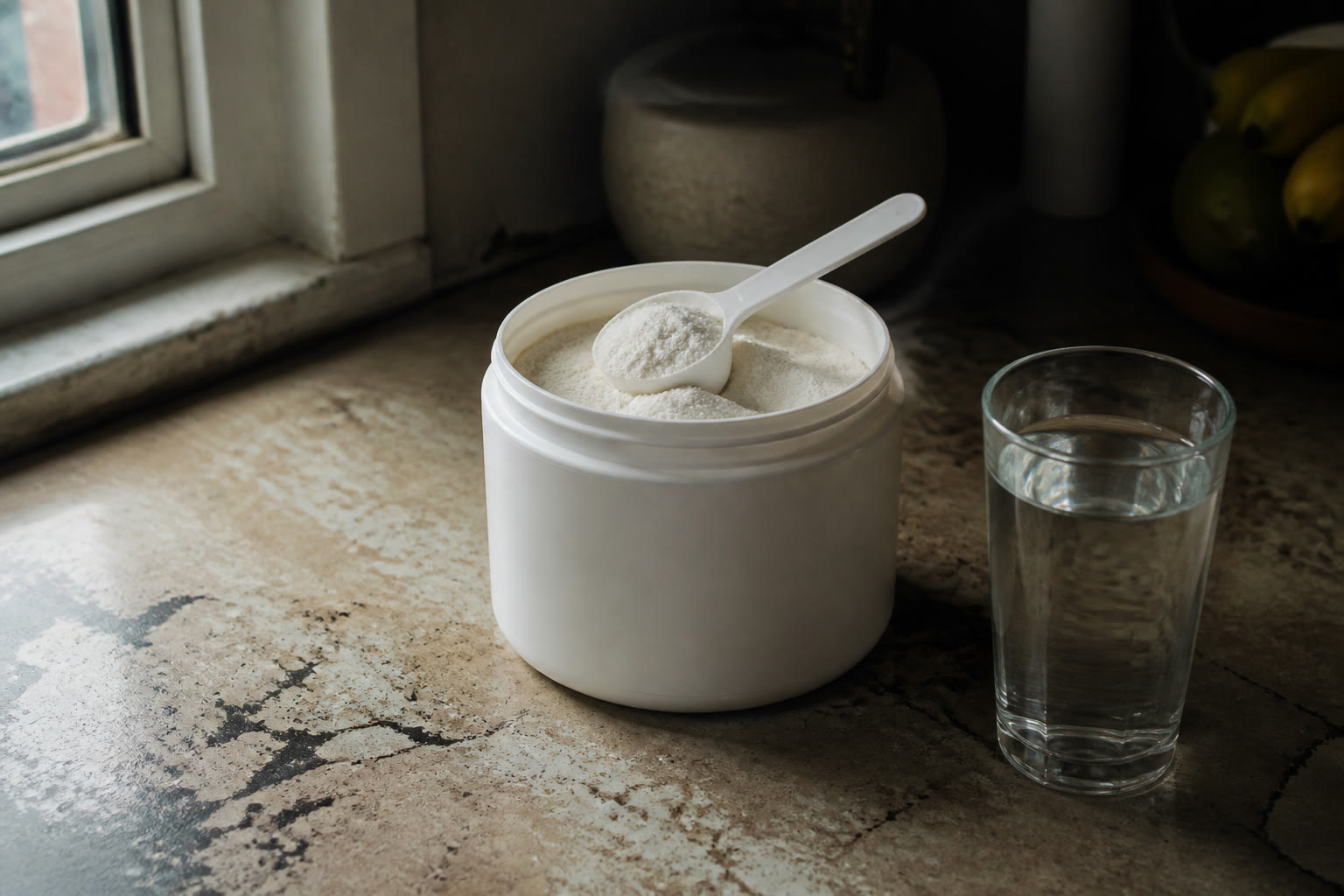
You do not have to load like a college kid
Hultman, Söderlund, Timmons, Cederblad and Greenhaff biopsied muscle in 31 healthy men — not older men — in 1996. Twenty grams a day for six days raised muscle total creatine about 20%. Two grams a day then held it. Without maintenance it was back to baseline by day 35. Three grams a day for 28 days produced a similar rise of about 20 mmol/kg dry mass, just slower. Loading is faster. It is not uniquely effective.
That is young-adult muscle-biopsy work, not a 55-year-old hypertrophy trial. Two grams a day in Hultman is a maintenance dose after loading, not the starting dose in most older-adult RCTs, which often used 5 g or about 0.1 g/kg. The International Society of Sports Nutrition’s 2017 position stand: the fastest method is about 0.3 g/kg/day for 5–7 days then 3–5 g/day; alternatively 3–5 g/day raises stores over 3–4 weeks, with less early performance data. NIH ODS says the same in slightly different clothes: typical protocol 20 g/day in four 5 g doses for 5–7 days then 3–5 g/day, or 3–6 g/day (0.03–0.1 g/kg) for 3–4 weeks without loading. Creatine monohydrate is 88% creatine by weight and is the most studied form. ISSN says the initial performance effects of the slow method are “less supported.” Loading still causes more gut complaints in some trials — Forbes notes GI distress during loading in Chrusch.
Forbes’s strength sub-analyses still lean toward an early load for upper-body, and toward more than 5 g/day — mostly relative g/kg protocols, not a magic 5.1 g scoop — for legs. When they stripped out loading trials, chest-press and leg-press no longer beat placebo. Absolute 5 g versus 0.1 g/kg has not been head-to-head in older men. If your gut is sensitive, skip the load. If you want saturation this week, 20 g/day split into four 5 g doses for 5–7 days is the method, not a personality.
Kidneys, the scale, and the form that has the evidence
In healthy people, creatine has not been shown to damage kidneys on gold-standard GFR. Serum creatinine can rise because creatine becomes creatinine. That is a lab-artifact risk, not proof of injury. It does not give a free pass to men with chronic kidney disease.
Lugaresi and colleagues: creatine 20 g/day for five days then 5 g/day for 12 weeks versus dextrose, in resistance-trained healthy men eating at least 1.2 g/kg/day of protein. GFR by 51Cr-EDTA clearance did not change. Creatine: 101.42 ± 13.11 before, 108.78 ± 14.41 after, in mL/min/1.73 m². Placebo: 103.29 ± 17.64 against 106.68 ± 16.05. Group × time F=0.21, p=0.64. No proteinuria or albuminuria. Analysed n=12 creatine and 14 placebo after dropouts from 23/23 randomised. The authors say, in words, that you cannot extrapolate this to people with or at risk of CKD, that 12 weeks is short, and that they had originally planned 12 months. These were young resistance-trained men, not 55-year-olds, and not CKD.
ISSN 2017, official point 2: no compelling scientific evidence that short- or long-term creatine monohydrate up to 30 g/day for five years has detrimental effects in otherwise healthy people. They cite the case reports of high creatinine and renal dysfunction that started the scare, then RCTs and athlete data showing no renal harm. They still write that people with pre-existing renal disease should consult a physician first, “in an abundance of caution.” That five-year, 30 g line draws heavily on clinical and neurodegenerative cohorts, not a ten-year healthy-ageing RCT in men 45 to 65. Chilibeck 2017: case reports in young intense trainers; no evidence from RCTs of serious adverse effects; the older-adult trials that checked kidney and liver were clean. Neither paper is a licence to ignore eGFR in a 60-year-old on an ACE inhibitor. I do not have an opened RCT of creatine in non-dialysis CKD. I also do not have an opened source on stacking creatine with ibuprofen. NSAIDs independently can reduce renal blood flow. That combination is a clinical judgement, not a creatine-specific finding I can cite.
Early scale weight is mostly water. Hultman’s group 4: 20 g/day cut 24-hour urine volume by about 0.6 L in the first days (p<0.001 versus placebo). The authors say acute body-mass gain is likely water retention, on a time course that matches muscle creatine uptake. ISSN: the only consistently reported side effect is weight gain; loading associated with about 0.5–1.0 L of short-term fluid retention, generally proportional to the acute weight gain. NIH ODS: no consistent set of side effects except that it often leads to weight gain, because it increases water retention and possibly stimulates muscle protein synthesis; several studies 1–2 kg of total body weight in a month with creatine during strength training. Chrusch’s 12-week DEXA lean of +3.3 versus +1.3 kg, plus 31% more training volume, is consistent with more work done, not a five-day pump. Chilibeck’s narrative: creatine may swell the cell osmotically, and that swelling is one proposed hypertrophic signal; biopsy fibre-area data in the older-adult set were mixed and underpowered. Nobody I opened partitioned intracellular water versus contractile protein in men 45 to 65. DEXA lean is not “muscle quality.” Acute 0.5–1 kg is not the same as 12-week 2 kg extra lean versus placebo. Do not sell a 7-day “muscle” transformation. ISSN also notes creatine can help heat tolerance via hyperhydration — the opposite of the cramp and dehydration myth — but that literature is mostly young athletes, and I am not going to over-claim Texas-summer safety in a 60-year-old from football studies.
The form with the evidence is creatine monohydrate. ISSN: it is the most effective researched ergogenic for high-intensity capacity and lean mass during training, and the most studied form for muscle uptake. NIH ODS: ethyl ester, AKG, buffered — “have not been proven to have superior ability to creatine monohydrate for enhancing muscle creatine levels, digestibility, product stability, or safety.” FDA GRAS notice 931, AlzChem Trostberg GmbH, “no questions” letter dated 12 November 2020 (corrected 3 December 2020): intended use 1.2 g creatine monohydrate per serving (1.0 g creatine) in energy drinks, protein bars and powders, shakes, meal replacements, meat analogs, dry drink mixes. That is a food-ingredient notice at 1 g creatine per serving. It is not an efficacy review of 3–5 g sports doses and it is not “FDA-approved creatine.” Creapure’s own page: 3–5 g daily, skip loading, drink fluid; they also market against cheaper generic creatine on impurity grounds. That is manufacturer competitive copy, not a head-to-head hypertrophy RCT. ISSN’s authorship is industry-adjacent. Forbes 2021: Candow sits on AlzChem’s scientific advisory board; Ostojic is on that board and holds creatine patents. EFSA 2016 was applied by AlzChem. Report the numbers. Do not pretend they arrived from nowhere.
What I would actually do
If you are a man 45 to 65, kidneys apparently healthy, coming back to lifting two or three days a week: creatine monohydrate, 3–5 g every day, mixed in water, for the duration of the training block. Think months, not a five-day challenge. Skip loading if your gut is sensitive. Load 20 g/day split into four 5 g doses for 5–7 days only if you want saturation this week. This is the cheap tub, not a patented matrix.
The extra, on top of the work you actually do, is on the order of 1 to 1.4 kg of lean-mass difference versus placebo in the older-adult metas, with small-to-moderate extra upper- and lower-body strength. Chrusch’s men, mean age 70, gained more, including a lot of extra training volume. The scale will jump 0.5–2 kg early from water. That is the product working, not fat and not a new identity. Tell the GP, and tell the lab, that you take creatine before a creatinine or eGFR blood test.
What I will not dress up. It does not heal kidneys, and it is not proven kidney-safe if you have CKD — the opposite: known CKD stays out unless a nephrologist owns it. I do not have a source that green-lights creatine in reduced GFR. It does not reverse sarcopenia, prevent falls, or replace testosterone. Those are not what the RCTs measured. It does not “only work if you load 20 g.” It is not only for 22-year-olds, and the opened healthy-kidney RCTs do not show it wrecks kidneys. I will not stack it with daily ibuprofen for “joint recovery” — I do not have a source for that combination. I will not claim endurance performance, hair loss, or that buffered creatine is easier on kidneys. I will not sell a before-and-after physique in seven days.
Cognition, bone, depression and the rest of ISSN’s medical laundry list are a thinner pile than the lifting-plus-lean-mass data. I did not open a DHT or hair RCT and I will not invent one. Fancy esters have not been shown to beat monohydrate on the pages I opened.
Do you need to buy anything
Only if you are going to lift. The metas required resistance training. If you are lifting, the product is creatine monohydrate, third-party tested, in a tub you can actually finish. Creapure is one documented high-purity manufacturer standard (≥99.9%). Any tested monohydrate is the evidence-based molecule. Do not upsell ethyl ester, HCl as “better,” or a sixty-dollar “bioavailable” blend. I am not putting a fake shop link under this paragraph.
When this is not the article
Known chronic kidney disease, or an unexplained high creatinine, is not a powder question. Lugaresi forbids the extrapolation. ISSN’s caution to ask a physician if you have pre-existing renal disease is the ceiling of what is sourced here. People not lifting are outside the metas. Anyone expecting an endurance bump is outside EFSA 2011 and NIH ODS. I am not in a position to diagnose you, and an article cannot read your eGFR.
Go and get it looked at properly if any of this fits: known kidney disease; unexplained rise in creatinine or drop in eGFR; you are on an ACE inhibitor, ARB or diuretic and nobody has looked at the combination; swelling, reduced urine, or a GP who has already told you to leave the kidneys alone. That list is not a diagnosis. It is the short list of things that deserve a professional look rather than a scoop.
How I checked this
Kin reviewed this piece on 2 September 2026, against the primary records rather than summaries of them. Nothing here about the body was written before that review, and where Kin's ruling and a seller's claim disagree, Kin wins.
- Established evidence 22 RCTs, 721 men and women, mean ages 57–70, resistance training 2–3 days/week for 7–52 weeks. Creatine beat placebo for lean tissue mass (mean difference 1.37 kg, 95% CI 0.97–1.76, p<0.00001), chest-press strength (SMD 0.35, 95% CI 0.16–0.53, p=0.0002) and leg-press strength (SMD 0.24, 95% CI 0.05–0.43, p=0.01). Effects held after dropping co-supplemented and chronic-disease trials. Just over half of individual trials were positive. Mixed-sex; inclusion required lifting; DEXA/hydrostatic/ADP lean includes water. Chilibeck PD, Kaviani M, Candow DG, Zello GA. Open Access J Sports Med. 2017;8:213–226 — full text, DOI 10.2147/OAJSM.S123529.
- Established evidence Forbes 2021 (mean age >50; 16 RCTs / 18 arms, n=509 for lean mass): lean-mass mean difference 1.32 kg (95% CI 0.93–1.72, p<0.000001); chest-press SMD 0.28 (0.09–0.47, p=0.004); leg-press SMD 0.20 (0.00–0.39, p=0.05). Ten of 20 tabulated trials null on lean mass and/or strength. Sub-analyses: loading then ≤5 g/day helped chest-press; >5 g/day (usually g/kg) helped leg-press; without loading trials, press lifts no longer beat placebo. Training-days-only showed a benefit here. Forbes SC, Candow DG, Ostojic SM, Roberts MD, Chilibeck PD. Nutrients. 2021;13(6):1912 — PMC8229907, DOI 10.3390/nu13061912. Candow on AlzChem SAB; Ostojic on AlzChem SAB with creatine patents.
- Early research Chrusch 2001: men 60–84, CRE n=16 mean age 70.4 vs PLA n=14 mean age 71.1, 12 weeks RT 3×/week. Loading 0.3 g/kg/day × 5 days (mean 26.4 g/day) then 0.07 g/kg/day (mean 6.2 g/day). Lean tissue +3.3 vs +1.3 kg; leg-press 1-RM +50.1 vs +31.3 kg; knee-extension 1-RM +14.9 vs +10.7 kg; training volume 31% higher. Bench-press 1-RM and bench endurance did not differ. GI loose stools in loading week; more cramping/strains, not enough to stop. Funded by MuscleTech. One familiarisation session before baseline 1-RM. Chrusch MJ, Chilibeck PD, Chad KE, Davison KS, Burke DG. Med Sci Sports Exerc. 2001;33(12):2111–2117 — opened PDF, DOI 10.1097/00005768-200112000-00021.
- Established evidence Hultman 1996, 31 healthy men (not older): 20 g/day × 6 days raised muscle total creatine ~20%; 2 g/day held it; without maintenance, baseline by day 35. 3 g/day × 28 days produced a similar ~20 mmol/kg dry-mass rise, slower. Group 4: 20 g/day cut 24-h urine volume ~0.6 L in the first days (p<0.001 vs placebo). Hultman E, Söderlund K, Timmons JA, Cederblad G, Greenhaff PL. J Appl Physiol. 1996;81(1):232–237 — opened PDF, DOI 10.1152/jappl.1996.81.1.232.
- Established evidence ISSN 2017 position stand: fastest method ~0.3 g/kg/day for 5–7 days then 3–5 g/day; alternatively 3–5 g/day over 3–4 weeks, with less early performance data. Monohydrate most studied. Only consistently reported side effect is weight gain; loading ~0.5–1.0 L short-term fluid retention. Official point 2: no compelling evidence of renal harm in otherwise healthy people up to 30 g/day for 5 years; still, consult a physician if pre-existing renal disease. Industry-adjacent authorship. Kreider RB et al. J Int Soc Sports Nutr. 2017;14:18 — full text, DOI 10.1186/s12970-017-0173-z. NIH ODS Health Professional fact sheet, creatine section: typical 20 g/day then 3–5 g, or 3–6 g/day without loading; fancy forms not proven superior; little value for endurance; weight gain 1–2 kg in a month with training — ODS fact sheet.
- Established evidence EFSA NDA Panel 2011: cause-and-effect for short-term, high-intensity, repeated bouts at 3 g creatine daily in adults doing high-intensity exercise. No cause-and-effect for endurance capacity or endurance performance. EFSA Journal 2011;9(7):2303 — opened PDF, DOI 10.2903/j.efsa.2011.2303. EFSA 2016 as restated in 2018 guidance: adults >55 in regular resistance training; ≥3 g/day plus RT 3×/week for several weeks improved muscle strength; similar weekly creatine on training days only did not. Applied by AlzChem. 2018 guidance PDF citing EFSA Journal 2016;14(2):4400.
- Early research Lugaresi 2013: RCT, creatine 20 g/day × 5 days then 5 g/day × 12 weeks vs dextrose, resistance-trained healthy men on ≥1.2 g/kg/day protein. GFR by 51Cr-EDTA unchanged (creatine Pre 101.42 ± 13.11 vs Post 108.78 ± 14.41 mL/min/1.73 m²; placebo 103.29 ± 17.64 vs 106.68 ± 16.05; group × time F=0.21, p=0.64). No proteinuria/albuminuria. Analysed n=12/14 after dropouts from 23/23. Authors: cannot extrapolate to CKD; 12 weeks is short; originally planned 12 months. Young men, not 55, not CKD. Lugaresi R et al. J Int Soc Sports Nutr. 2013;10:26 — full text, DOI 10.1186/1550-2783-10-26.
- Established evidence FDA GRAS Notice 931, creatine monohydrate, AlzChem Trostberg GmbH. FDA “no questions” letter 12 Nov 2020 (corrected 3 Dec 2020). Intended use: 1.2 g creatine monohydrate/serving (1.0 g creatine) in foods. Food-ingredient notice, not a 5 g sports monograph and not a drug approval — GRN 931. Creapure manufacturer page: ≥99.9% creatine monohydrate; 3–5 g daily; loading “unnecessary and not recommended by us”; impurity marketing vs generics is competitive copy, not a hypertrophy RCT — Creapure athletes page.
- Guy's opinion That a man 45–65 with apparently healthy kidneys, lifting 2–3 days a week, should take 3–5 g monohydrate daily for the training block and skip the esters. The numbers above are from the papers. Applying them to you is the guess, and I would rather say so than dress it up.
What I don't know: I do not have an opened RCT of creatine in non-dialysis CKD. I do not have a source that partitions intracellular water versus contractile protein in men 45–65. I do not have a head-to-head of absolute 5 g versus 0.1 g/kg in older men. I do not have an opened trial, FDA label, or ODS table for a creatine–NSAID pharmacokinetic interaction. Long-term renal follow-up in healthy men 45–65 on 3–5 g/day is thin; ISSN’s five-year / 30 g line is mixed clinical populations, and the athlete data to ~21 months (Kreider 2003, cited inside ISSN) was not opened here. Poortmans 1999 is cited inside ISSN and Lugaresi; I did not open that PDF and I am not citing it as a primary. Hair-loss: I did not open a DHT trial. ISSN notes vegetarians may respond more, and Hultman-era work describes non-responders; I have not opened a vegetarian-only older-adult RCT. Most metas pool men and women; some mixed trials reported lean/strength benefit in men only. I am not treating the mixed-sex mean as a men-only effect size. Forbes’s older-adult RCTs average about 34 people and split roughly 50/50 significant versus null. The mean extra lean mass is about 1.3–1.4 kg over weeks to a year of lifting — real, modest, not a transformation.