Getting back into it
Skip the $9,990 ice bath: CWI can dull next-day soreness — and also next-month muscle, if you sit in it after lifting
Cold-water immersion can take the edge off delayed soreness versus sitting still. Used after strength work, the same habit taxes the hypertrophy you are paying the gym for. Home chillers run colder than the trials, and they are not a cardiac toy.
If you have a cardiac history, take a beta blocker, or you have ever blacked out around water, this is not your article. Start at the last section. I am not in a position to diagnose you, and a tub cannot.
The fight is cold-water immersion for soreness and recovery versus cost, cardiac risk in men 45–65, and blunting of hypertrophy when you sit in it after strength work. Feeling less sore is not the same as more muscle. The opened trials are mostly young. I am going to say so.
Soreness versus sitting still
Cochrane, Bleakley and colleagues: 17 small RCTs, 366 participants. Mean ages 16–29 years; 19% female. Study quality low. CWI defined as immersion in water under 15°C. Most popular protocol in the included trials: 10–15°C; continuous immersions averaged 12.6 minutes; some used 5°C or 9°C; depth from a single limb to waist, sternum or shoulder. Versus passive rest, pooled muscle-soreness SMDs favoured CWI at 24 h (−0.55, 95% CI −0.84 to −0.27; 10 trials), 48 h (−0.66, −0.97 to −0.35; 8 trials), 72 h (−0.93, −1.36 to −0.51; 4 trials), 96 h (−0.58, −1.00 to −0.16; 5 trials). Heterogeneous. Larger effects in crossover designs and after running-based exercise than after lab eccentric/DOMS protocols. Two trials: lower fatigue immediately after CWI (MD −1.70 on a 10-unit scale). Exploratory conversion of pain to a 10 cm VAS suggested about 1.3–2.2 cm less soreness at 24–72 h. Versus contrast immersion (5 trials) and warm-water immersion (4 trials): no important differences on pain. Single trials versus active recovery and versus compression garments: no important differences. The majority of trials did not actively surveillance predefined adverse events. Authors: “some evidence” CWI reduces DOMS versus rest; “optimum method of cold-water immersion and its safety are not clear.”
That review does not show CWI beats ice packs, sleep, or protein. It does not establish an optimal temperature, duration, or depth. It does not prove performance restoration. It does not include men 45–65 as a studied group. It does not clear cardiac safety. It does not support a daily home-plunge habit. Participants cannot be blinded to ice water; only one trial (Sellwood) even attempted outcome-assessor blinding. Part of the soreness effect may be expectation.
A bag of ice on the sore muscle is not the same physiologic hit as sitting in 3–10°C water to the waist. Cochrane’s CWI review did not include ice-pack arms. Versus contrast, warm water, compression tights, or a jog: no important differences. So the unique selling point of a sit-in tub for DOMS, versus cheaper cold or other recovery, is not established in that review. Bleakley’s 2004 ice review — acute sprains and post-op, not gym DOMS — 22 RCTs, mean PEDro 3.4/10: marginal evidence ice plus exercise helps after ankle sprain or surgery; little evidence ice adds to compression; no optimal mode or duration. Local ice cools a joint or muscle without whole-body cold shock, without a 100-gallon shared reservoir, and without the hydrostatic and cardiac load of immersion. That is not a head-to-head of ice pack versus Plunge All-In in men 45–65. It is also not a claim that ice packs grow muscle.
What it does to the lifting you came for
Using CWI as a regular recovery after strength training attenuates long-term gains in muscle mass and, in the key 12-week trial, strength. Roberts, 2015, two studies in physically active men with at least 12 months of strength-training experience — not men 45–65.
Study 1: 21 men completed 12 weeks, 2 sessions/week of lower-body strength plus plyometrics. Within 5 minutes of each session: 10 minutes CWI at 10.1 ± 0.3°C, both legs to the waist, or 10 minutes easy bike (59.5 ± 9.4 W). Standardised whey around sessions. Quadriceps mass by MRI rose in both groups, but less with CWI: +103 ± 71 g versus +309 ± 73 g (between-group 206 g; d = −4.1; P < 0.001). Type II fibre CSA rose 17.1 ± 5.1% in active recovery (P = 0.009), not in CWI (P = 0.10). Myonuclei per type II fibre +26.1 ± 4.2% in active recovery, not CWI. Leg-press 1RM gain 201 ± 65 kg versus 133 ± 43 kg (57 kg difference; d = 1.5; P = 0.033). Knee-extension 1RM 33.8 ± 8.5 kg versus 17.8 ± 9.2 kg (P < 0.001). Isometric torque and RFD also favoured active recovery. The CWI group still gained some mass and 1RM. It did not “kill all gains.”
Study 2: 9 men, crossover, single-leg strength then CWI 10.3 ± 0.5°C or easy bike. Pax7+ satellite cells rose 24–48 hours after active recovery, not after CWI; NCAM+ cells delayed or blunted with CWI. p70S6K Thr421/Ser424 phosphorylation higher after active recovery at 2 hours and 24 hours. Authors: people who use strength training “to improve athletic performance, recover from injury or maintain their health should therefore reconsider whether to use cold water immersion as an adjuvant to their training.”
Fuchs 2020: twelve recreationally active men, age 21 ± 2 years. After bilateral leg press and extension, 20 minutes immersion to the gluteal fold: one leg 8°C, contralateral 30°C. Then 20 g intrinsically labelled milk protein plus 45 g carbohydrate. Over 5 hours, dietary protein-derived phenylalanine in myofibrillar protein: 0.016 ± 0.006 versus 0.021 ± 0.007 MPE (CWI versus CON; P = 0.016). 0–5 hour FSR lower with CWI (leucine tracer 0.058 ± 0.011 versus 0.072 ± 0.017 %·h⁻¹, P = 0.024; phenylalanine tracer 0.042 ± 0.009 versus 0.053 ± 0.013 %·h⁻¹, P = 0.025). Same-leg protocol after every session for 2 weeks (7 sessions): daily myofibrillar FSR 1.48 ± 0.17 versus 1.67 ± 0.36 %·day⁻¹ (P = 0.042). Thigh skin about 20.5°C colder and muscle about 5°C colder immediately after CWI. Authors: people aiming to improve skeletal muscle conditioning “should reconsider applying cooling as a part of their postexercise recovery strategy.” This is single-leg to the fold, not a whole-body sit-in tub. It does not measure 12-week hypertrophy — that is Roberts. It does not test delaying CWI many hours after lifting. It does not test older men.
The hypertrophy penalty is mode-specific. Ihsan’s 2021 mini-review: typical recovery CWI is submersion to waist or mid-torso, about 5–20 minutes, about 8–15°C. Malta 2021 meta-analysis is cited there — I did not open Malta’s full text — resistance-training adaptations diminished; aerobic performance seemed unaffected. Regular post-resistance CWI can attenuate anabolic signalling, protein synthesis, fibre hypertrophy and/or some strength outcomes. Endurance: CWI can raise PGC-1α/VEGF mRNA and, in some training studies, mitochondrial markers or capillarity, but those molecular changes have not reliably translated into better endurance performance; CWI does not appear to impair aerobic training adaptations. Ihsan proposes periodising recovery: use CWI in competition or intensified blocks; avoid it immediately after sessions aimed at strength or hypertrophy. Applied studies in rugby, MMA, basketball and volleyball often placed CWI after technical or conditioning work, not immediately after gym, and did not show the same strength impairments as lab hypertrophy trials. That review does not give a safe “wait X hours after lifting” number. It does not prove CWI improves VO2max. It does not study 45–65-year-old recreational lifters. Fyfe 2019 I have as an abstract only (men 22.9 ± 4.6 years): type II CSA blunted, 1RM leg press similar. I am not collapsing Fyfe and Roberts into one sentence.
The $9,990 tub is not the protocol
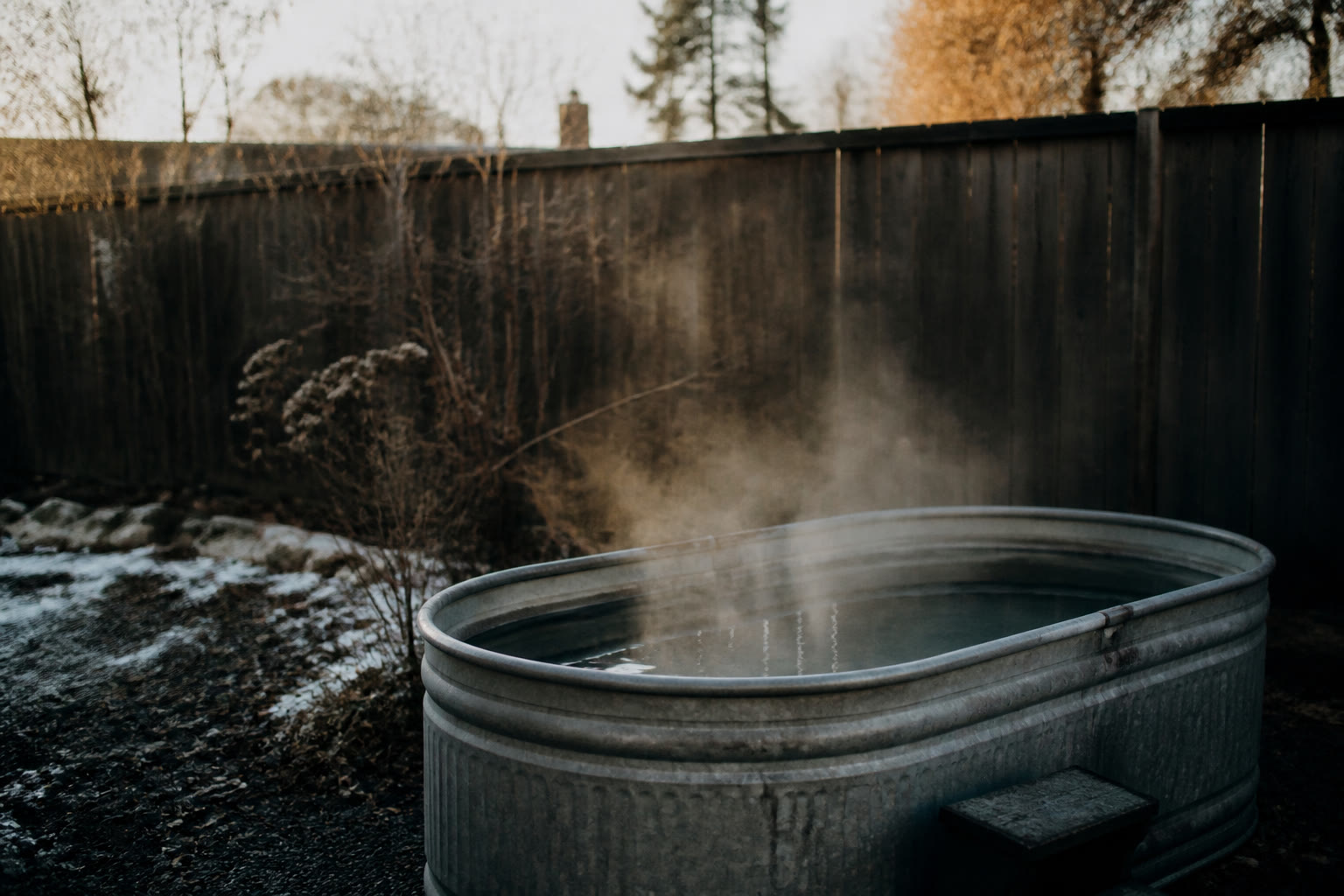
Home chiller tubs are sold to run colder than the 10–15°C research band. Prices on opened product pages are not $7,000 as a list figure. Plunge All-In on Rogue: $8,990, from $9,990; max cooling 37°F / 3°C; about 100 gallons; 1 HP; ozone plus 20-micron filter; 120 V / 15 A dedicated. Da Vinci Medical USA: $9,990.00; same 37°F / 3°C (the page also says “cools … to 39°F” in body copy). Recovery Outlet: $7,990.00 sale, regular $9,990; max cooling 37°F (3°C); dealer badge “FDA Registered.” Ice Barrel 300 manufacturer page: $1,149.99; ice or add-on chiller; 77 gallons; no published setpoint — ice-dependent. Temperd spec page: temperature range 3.0°C (37°F)–40°C (104°F); price not captured on that open.
Integrated home chillers advertise floors around 3°C / 37°F — colder than Cochrane’s typical 10–15°C and Roberts’ 10°C. Sale prices seen: $7,990 and $8,990 off a $9,990 list; not a $7,000 SKU. I will not invent a $7,000 figure as list price. Product pages do not prove clinical benefit. “FDA Registered” is not a 510(k) or PMA opened in this brief, and it is not clearance to treat DOMS, inflammation, or heart disease. No FDA device-clearance page for a home ice bath as a treatment for muscle injury was opened. I will not paste dealer copy about dopamine or “250%” mood effects — that is on a Da Vinci page, not a trial we opened.
Cold shock is not a wellness extra
Cold shock is a real, immediate cardiac-respiratory hit. AHA News, 9 December 2022, quoting clinicians — this is news, not a formal AHA scientific statement on home ice baths. Evidence for health benefits of cold therapy “remains scant.” National Center for Cold Water Safety, quoted by AHA: sudden immersion in water under 60°F (15.6°C) can kill a person in less than a minute. Dr Jorge Plutzky, preventive cardiology, Brigham and Women’s: “That cold shock can be dangerous.” “Whether there are health benefits or not is not clear and has not been established.” “I would caution against it for anyone with a cardiac history.” Little CWI research included people with heart conditions. Cold shock: sudden rise in breathing, heart rate, and blood pressure; involuntary gasp with the head under can drown in seconds; heart is stressed. Beta blockers, which lower HR and BP, “could make it harder for the body to adapt.” Most dangerous window: first 10 seconds to a minute. Blood shunts from limbs to core; coordination can go. Water pulls heat about 25 times faster than air. Some winter-swim data: higher troponin, suggesting possible myocardial injury with prolonged immersion — AHA does not give a number in the piece. Lee Hill, quoted: never do a cold-water swim alone; after exit, strip wet clothes, rewarm; hypothermia risk continues out of the water. AHA does not print “uncontrolled hypertension” as a phrase in this article; the BP surge is the physiology. Named afterdrop in degrees Celsius for a 10-minute home plunge is not in what I opened; Webb 1986 was not opened in full. Cochrane notes that in Halson 2008, 3 minutes at 11.5°C after exercise in heat did not drop mean core below 37°C.
Tipton 1989, abstract: cold-shock can kill or incapacitate long before hypothermia; “probably responsible for the majority of annual open-water immersion deaths.” Shattock and Tipton 2012: cold shock is sympathetically driven — tachycardia, gasp, hyperventilation, vasoconstriction, hypertension — from cutaneous cold receptors, classically under 15°C. Diving response (face cooling plus apnoea) is parasympathetic bradycardia. Simultaneous activation is autonomic conflict. In young healthy people: arrhythmias in about 2% of head-out free-breathing cold immersions versus 62–82% with submersion plus breath-hold. Arrhythmias mostly supraventricular or junctional, often within 10 seconds of breaking the breath-hold. Predisposing: long QT, ischaemic heart disease, QT-prolonging drugs, channelopathies. Head-under plus breath-hold is a different arrhythmia problem than a seated, head-out tub. I am not saying every home plunge is polar-bear drowning. I am saying the cardiac literature is not a 10-minute gym recovery RCT, and Cochrane cannot call CWI safe because the trials did not look.
Shared or dirty cold water is a hygiene problem. Cold does not make the tub self-sterilising; it slows chlorine kill-time. NCCEH evidence brief, Chen, 24 April 2024: waterborne pathogens, cold-shock and heart events, slips, suction/entrapment. Pathogens can persist; chlorine disinfection is slower at low temperature — example given: 3-log Giardia at 2.0 mg/L Cl₂, pH 7: 124 minutes at 10°C versus 62 minutes at 20°C. Typical 20-micron plunge filters do not remove Cryptosporidium. Ozone and UV do not leave a residual. One Queensland sampling study (Mundy 2018, cited): 64% of samples from mobile inflatable hot/cold tubs positive for E. coli/coliforms, P. aeruginosa, and/or S. aureus despite variable chlorine; fixed recirculating tanks mostly negative. Shared ice baths implicated as a possible factor in MRSA (Australian football) and MSSA (English rugby) team outbreaks. People with open sores should not use shared plunges. MAHC, via NCCEH: cold-plunge tanks often 7–10°C. Outbreaks are shared team baths, not a single covered home tub. Still: cold water plus skin plus poor sanitation is not theoretically sterile. The CDC page opened in search is hot-tub operations. I am not pasting hot-tub ppm rules as if they were a cold-plunge RCT. Ice packs skip the shared-water issue.
What I would actually do
If a screened, heart-healthy man wants less next-day soreness after a hard endurance or tournament block, a short, head-out immersion in the research band — about 10–15°C, about 10–15 minutes — not immediately after a hypertrophy session, is the only use the Cochrane plus Ihsan stack actually supports. And even then only versus sitting still, not versus sleep, protein, or an ice pack. A $1,149 ice barrel or a stocked bathtub of tap water plus ice can hit 10–15°C without a $9,990 chiller. Do not plunge alone. Get out if gasping or dizzy. Dry and rewarm.
What I will not dress up. A 3°C / 37°F daily sit-in tub as “the protocol the studies used.” Studies used about 10°C, not ice-slush. A 45–65-year-old lifter told that a home ice bath will “optimize recovery and muscle.” After lifting, opened trials say it taxes the very adaptations he is paying the gym for. A man with CAD, heart failure, arrhythmia, prior MI, unexplained syncope, long QT, or on beta blockers, dunked in sudden cold water. AHA clinician: caution against it for anyone with a cardiac history; benefits “not established.” Uncontrolled high BP: same physiology — acute pressor burst — send to his doctor, do not dunk. That last sentence is a clinical inference from the BP surge, not a phrase AHA printed. I will not imply FDA-cleared therapy. I will not invent $7,000. I will not claim CWI beats an ice pack or compression for DOMS. Raynaud’s: Cochrane assumed such patients would be excluded from cryotherapy trials.
Do you need to buy anything
No. Ice on the sore quad is the low-drama alternative: local analgesia, no cold-shock, no 100 gallons of water to sanitise, no hypertrophy literature hanging over it. If you still want a sit-in after an endurance block, a barrel and a bag of ice, or a bathtub, can hit the research band. I am not putting a fake affiliate URL under a $9,990 chiller that runs 7 degrees colder than the trials.
When this is not the article
Cardiac history, heart failure, arrhythmia, prior MI, unexplained syncope, long QT, beta blockers, uncontrolled blood pressure, or anyone who has ever needed help getting out of water. Chest pain, severe breathlessness, or dizziness in the first minute is not a “lean into the discomfort” cue — it is get out and get looked at. Open sores and a shared tank: stay out. I am not in a position to clear you for cold shock. A clinician who knows your heart will get further in ten minutes than I can here.
How I checked this
Kin reviewed this piece on 2 September 2026, against the primary records rather than summaries of them. Nothing here about the body was written before that review, and where Kin's ruling and a seller's claim disagree, Kin wins.
- Established evidence Bleakley C et al. Cochrane Database Syst Rev. 2012 (evidence page updated 1 April 2022). 17 small RCTs, 366 participants, mean ages 16–29. CWI <15°C; typical 10–15°C, continuous immersions averaged 12.6 min. Soreness SMDs vs rest: 24 h −0.55 (−0.84 to −0.27); 48 h −0.66; 72 h −0.93; 96 h −0.58. No important differences vs contrast, warm water, compression, or a jog. Most trials did not surveillance adverse events. DOI 10.1002/14651858.CD008262.pub2, PMC6492480, Cochrane evidence page.
- Early research Roberts LA et al. J Physiol. 2015;593(18):4285–4301. 12-week lower-body strength + plyometrics; 10 min CWI at 10.1 ± 0.3°C vs easy bike. Quadriceps MRI +103 ± 71 g vs +309 ± 73 g; type II CSA +17.1 ± 5.1% in active recovery, not CWI; leg-press 1RM +201 ± 65 vs +133 ± 43 kg. Acute arm: Pax7+ and p70S6K blunted after CWI. Not men 45–65. DOI 10.1113/JP270570, PubMed 26174323, opened QUT manuscript.
- Early research Fuchs CJ et al. J Physiol. 2020;598:755–772. Men 21 ± 2 y; 20 min single-leg 8°C vs 30°C to the gluteal fold after lifting. Dietary phenylalanine in myofibrillar protein 0.016 ± 0.006 vs 0.021 ± 0.007 MPE (P=0.016); 0–5 h FSR lower with CWI; 2-week daily myofibrillar FSR 1.48 ± 0.17 vs 1.67 ± 0.36 %·day⁻¹ (P=0.042). DOI 10.1113/JP278996, PMC7028023.
- Early research Ihsan M, Abbiss CR, Allan R. Front Sports Act Living. 2021. Typical CWI ~5–20 min, ~8–15°C. Cites Malta 2021 (full text not opened here): resistance adaptations diminished; aerobic performance seemed unaffected. Periodise: avoid CWI immediately after hypertrophy sessions. DOI 10.3389/fspor.2021.714148, full text. Fyfe 2019 abstract only (DOI 10.1152/japplphysiol.00127.2019): type II CSA blunted, 1RM leg press similar; men 22.9 ± 4.6 y; full PDF not opened.
- Manufacturer copy Plunge All-In, Rogue: $8,990 from $9,990; max cooling 37°F / 3°C — Rogue page. Da Vinci Medical USA: $9,990.00 — Da Vinci page. Recovery Outlet: $7,990.00 sale / $9,990 regular; dealer “FDA Registered” — Recovery Outlet. Ice Barrel 300: $1,149.99; 77 gal; no published setpoint — Ice Barrel 300. Temperd: 3.0°C (37°F)–40°C (104°F); price not captured — Temperd spec. No opened 510(k)/PMA that a home plunge treats DOMS or CVD.
- Early research AHA News, Williamson L, 9 Dec 2022. Clinician quotes, not a formal AHA guideline. Caution against cold plunge for anyone with a cardiac history; benefits “not established”; cold shock in the first 10 seconds to a minute; beta blockers flagged — AHA News. Tipton MJ. Clin Sci. 1989;77:581–588. Abstract: cold-shock can kill long before hypothermia. DOI 10.1042/cs0770581, PubMed 2691172. Shattock MJ, Tipton MJ. J Physiol. 2012;590:3219–3230. Arrhythmias ~2% head-out free-breathing vs 62–82% submersion + breath-hold. DOI 10.1113/jphysiol.2012.229864, PMC3459038.
- Early research Chen T. NCCEH evidence brief, 24 Apr 2024. Chlorine 3-log Giardia 124 min at 10°C vs 62 min at 20°C (2.0 mg/L Cl₂, pH 7). 20-micron filters do not remove Cryptosporidium. Mundy 2018 cited: 64% of mobile inflatable tub samples positive despite variable chlorine. Shared ice baths implicated in team MRSA/MSSA outbreaks — NCCEH brief. CDC healthy-swimming page opened is hot-tub ops, not a cold-plunge RCT — CDC pools/hot tubs.
- Early research Bleakley C, McDonough S, MacAuley D. Am J Sports Med. 2004;32(1):251–261. Ice for acute soft-tissue injury, not gym DOMS. 22 RCTs, mean PEDro 3.4/10; marginal evidence ice + exercise after ankle sprain/surgery; little evidence ice adds to compression. DARE summary NBK70552, PubMed 14754753.
- Guy's opinion That a heart-healthy man should skip the $9,990 chiller, skip the post-lift sit, and put ice on the sore quad if he wants cold at all. The trials measured young men at about 10°C. Applying that to a 55-year-old in a 3°C home tub is the guess I will not dress up as a protocol.
What I don't know: no opened trial is a 45–65 men’s-health sample. Cardiac risk is inferred from physiology plus AHA clinician quotes, not from ice-bath RCTs in CAD or hypertension. Malta 2021 and Fyfe 2019 full texts were not opened. Webb 1986 afterdrop paper was not opened in full; I will not invent afterdrop °C for a 10-minute home plunge. No quantified home-tub infection rate for a single user who chlorinates and covers the tub. No opened 510(k)/PMA. No safe “wait X hours after lifting” number. Uncontrolled hypertension is a clinical no from the BP surge; it is not a sentence AHA printed.